A REPEATABLE METHOD
How to use it
- Identify the meter by its serial number and the supply it serves. Note shared supplies and separate irrigation meters. Keep a photo of the register and units where this can be taken safely; do not assume the nearest meter serves your home.
- Use the meter-specific instructions to find cumulative volume. A display in L/min or L/h is a flow rate, not the cumulative reading. Confirm m³, kL or another unit and any multiplier; do not apply a universal rule based only on digit colours.
- Record the full readable volume, date, time and register resolution. For this site’s meter-consumption calculator, convert to m³: 1 kL = 1 m³ = 1000 L. Keep readable decimal places for monitoring even if the supplier requests a different format for billing.
- Take a second reading from the same unchanged meter and register, with its actual time. Subtract the starting value. If the register decreased, stop and check transcription, meter identity, replacement or rollover; do not turn the difference positive automatically.
- For a no-use check, account for automatic water use as well as taps. EPA WaterSense suggests comparing readings over two hours without use. A change calls for investigation; the meter does not identify the cause. A zero displayed change does not exclude an intermittent or smaller-than-resolution loss.
INTERPRET THE MEASUREMENT
How to read the result
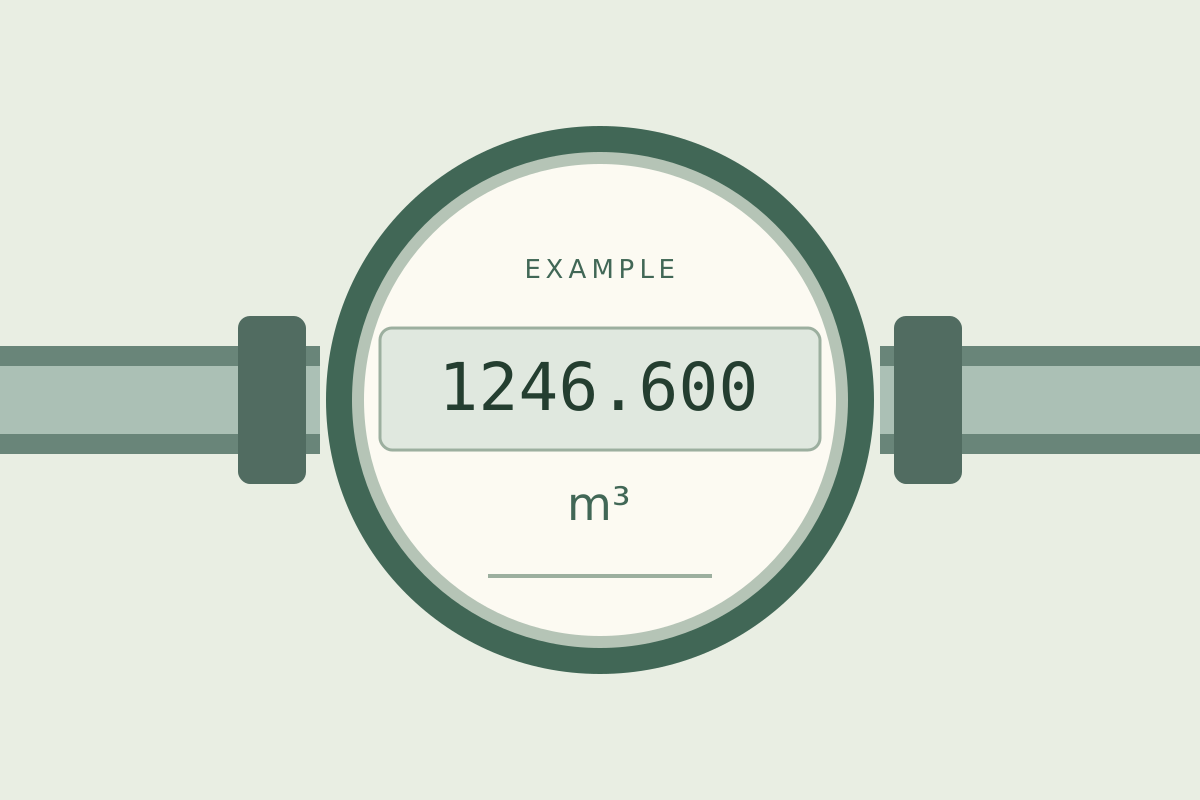
- Worked example, not a household benchmark: 1246.600 − 1234.000 = 12.600 m³ = 12600 L. Over exactly 14 days this is 900 L/day. The final total 1246.600 m³ is not the interval consumption.
- A fictional 0.006 m³ increase over 30 minutes is 6 L / 30 min = 0.2 L/min average for that interval. It does not establish peak flow, a continuous daily leak, or where the water went.
- If the readable increment is 0.001 m³, that increment represents 1 L. Display resolution is not an accuracy specification. Do not report a sub-litre change from two readings rounded to whole litres; choose a useful safe observation period and document the limitation.
- Record: meter serial and location; cumulative register and unit; initial and final values; both timestamps; readable increment; occupants and known automatic/irrigation use; replacement or service events. Compare equal durations or normalize by actual elapsed time.
TROUBLESHOOT THE METHOD
Common problems and what to check
The value is lower than last time.
Recheck the photo, units and serial number. Start separate intervals around a replacement, reset or confirmed rollover; obtain the supplier’s instructions rather than adding an assumed register capacity.
The meter moves while taps are closed.
Check scheduled irrigation, toilet refills and treatment cycles before labelling the change a hidden leak. Record the conditions, follow the household leak-check guide and contact a competent plumber or supplier for unexplained ongoing flow.
The register does not visibly change during a short check.
Check you are reading the correct volume register and note its readable increment. Do not dismantle the meter, force a display control or claim there is no leak from an observation that cannot resolve small or intermittent use.
STOP BEFORE THE HAZARD
Safety boundary
- Do not enter a chamber or tank, lift a heavy or damaged cover, reach into standing water or work in traffic to obtain a reading. Ask the supplier for safe access when the meter cannot be read safely.
- Do not break seals, undo pressurised joints or remove a utility-owned meter. Replacement, plumbing changes and disputed readings require the responsible supplier or appropriately qualified installer.
- Do not shut off essential systems, fire protection or equipment that needs water merely to create a no-use test. Arrange a suitable check with the responsible professional when all consumption cannot safely stop.
SMART BUYING GUIDE
What to look for when choosing
- For an existing meter, obtain the correct register instructions before buying a separate monitor. A remote portal and the physical register may have different timestamps or reporting intervals.
- If considering a submeter, specify the pipe, temperature, expected flow range and readable increment with a qualified installer. Billing approval, ownership and local installation requirements are separate questions, not established by this guide.
- An accessible register and exportable dated records are useful for comparison. More display digits or a leak alert do not by themselves prove accuracy or guarantee detection.
Types of tool
Best for: Manual interval records when the scale and multiplier are known; a moving indicator is not a calibrated flow reading unless the model documents it.
Best for: Dated volume records and, on supported models, separate flow screens; check the exact register, time interval and data availability.
Common functions
Worth paying more for
- Safe access and a legible register
- Documented units, register resolution and timestamped records
Usually not worth the extra cost
- Extra digits presented as guaranteed accuracy
- An alert presented as proof of leak location or drinking-water safety
Sources & instructions
- Water Corporation — standard and smart meter registers (Australian supplier examples; model-specific)
- US EPA WaterSense — two-hour no-use meter check; screening, not fault location
Original schematic with a fictional reading, not a photograph, calibration reference or instruction for a particular meter model.
Put the measurements to work
Turn pipe dimensions, tank levels, pressure settings and pump run time into four useful commissioning numbers.
Find and quantify a hidden household water leakUse the water meter, simple isolation tests and a timed measurement to turn unexplained consumption into a repairable fault.