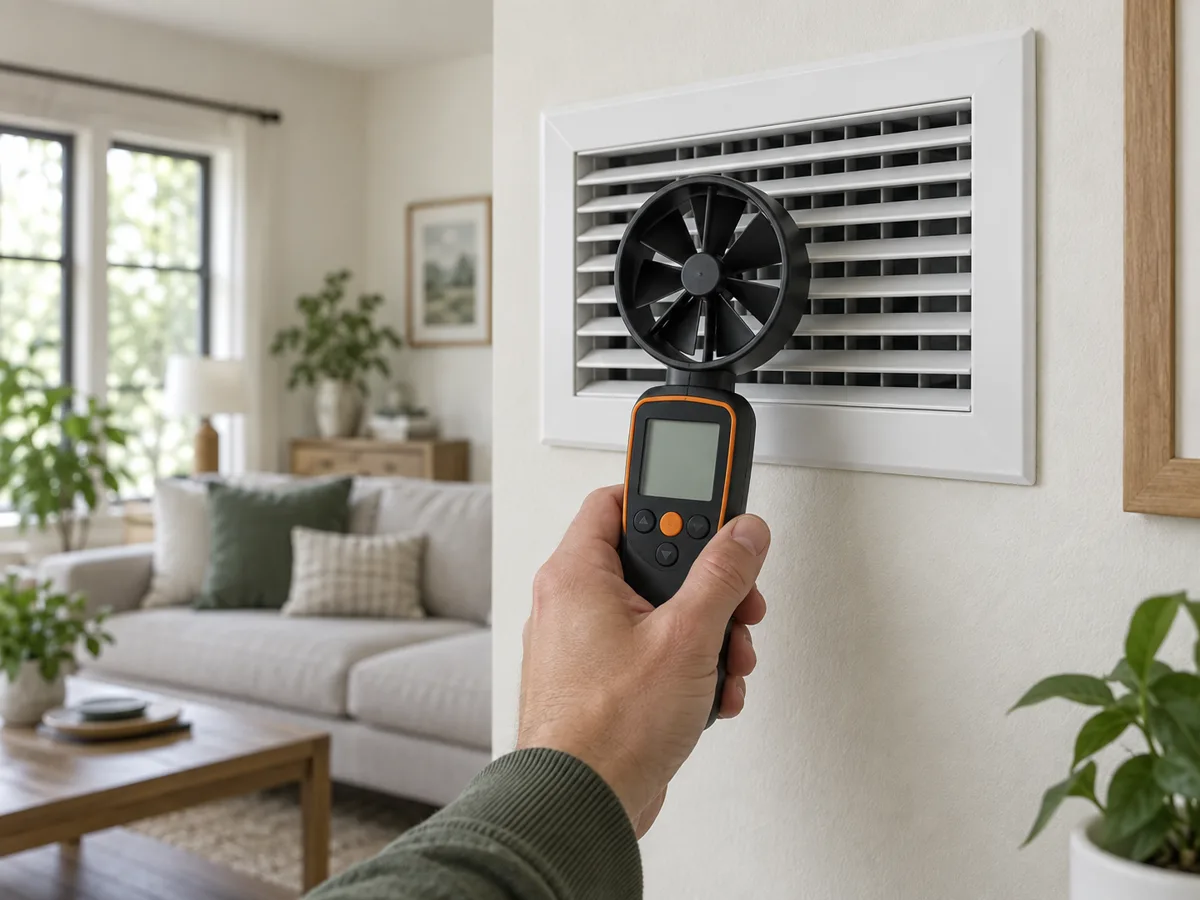
A REPEATABLE METHOD
How to use it
- Confirm airflow direction, select the correct units and allow the instrument to stabilize in the room conditions.
- Measure the free or effective area using manufacturer data when available; the outside grille dimensions are usually not the open area.
- Hold the vane square to the flow without blocking the grille and take readings on a repeatable grid across the face.
- Average the readings, note the ventilation setting and apply the appropriate area or diffuser correction.
- Repeat at other terminals and operating modes, then compare supply and extract totals with the design and local requirements.
INTERPRET THE MEASUREMENT
How to read the result
- Velocity multiplied by area gives volume flow only when both represent the same flow field and units are consistent.
- Swirl, angled vanes and proximity to the grille can make face velocity differ from duct-average velocity.
- Stable repeatability between tests is often more useful than false precision from one turbulent point.
TROUBLESHOOT THE METHOD
Common problems and what to check
Problem
Readings jump around the grille.
What to do
Use a larger time average and a regular grid. Keep your body and hand out of the air path and avoid measuring during gusty outdoor conditions.
Problem
Calculated flow is much higher than expected.
What to do
Check whether you used gross face area instead of free area and whether the diffuser needs a correction factor.
Problem
Supply and extract totals do not balance.
What to do
Repeat the traverse at every terminal and operating mode, check filters and dampers, and use a capture hood or professional balancing method when needed.
STOP BEFORE THE HAZARD
Safety boundary
- Keep probes, fingers and loose material away from accessible fans and moving dampers.
- Use safe access equipment for high grilles and do not remove covers from energized air-handling equipment.
- Airflow measurement does not confirm fire, combustion, pressure-balance or indoor-air-quality compliance by itself.
SMART BUYING GUIDE
What to look for when choosing
- Choose a velocity range and starting threshold suited to low residential air speeds, not just high industrial flow.
- A remote vane, time averaging and direct volume-flow entry can improve repeatability at awkward grilles.
- For commissioning many terminals, a calibrated capture hood may be better value than a premium hand vane.
Types of tool
Best for: Quick checks on accessible grilles and open air.
Best for: Repeatable traverses while the display stays visible.
Best for: Direct terminal-flow measurement and system balancing.
Common functions
Low-speed sensitivityTime averagingMin/max captureArea and volume-flow modeData logging
Worth paying more for
- Good low-velocity response
- Time averaging and a remote probe
- Calibration documentation for balancing work
Usually not worth the extra cost
- Very high velocity range for household grilles
- Many unit modes without reliable low-speed response
- App features that do not preserve raw readings and conditions