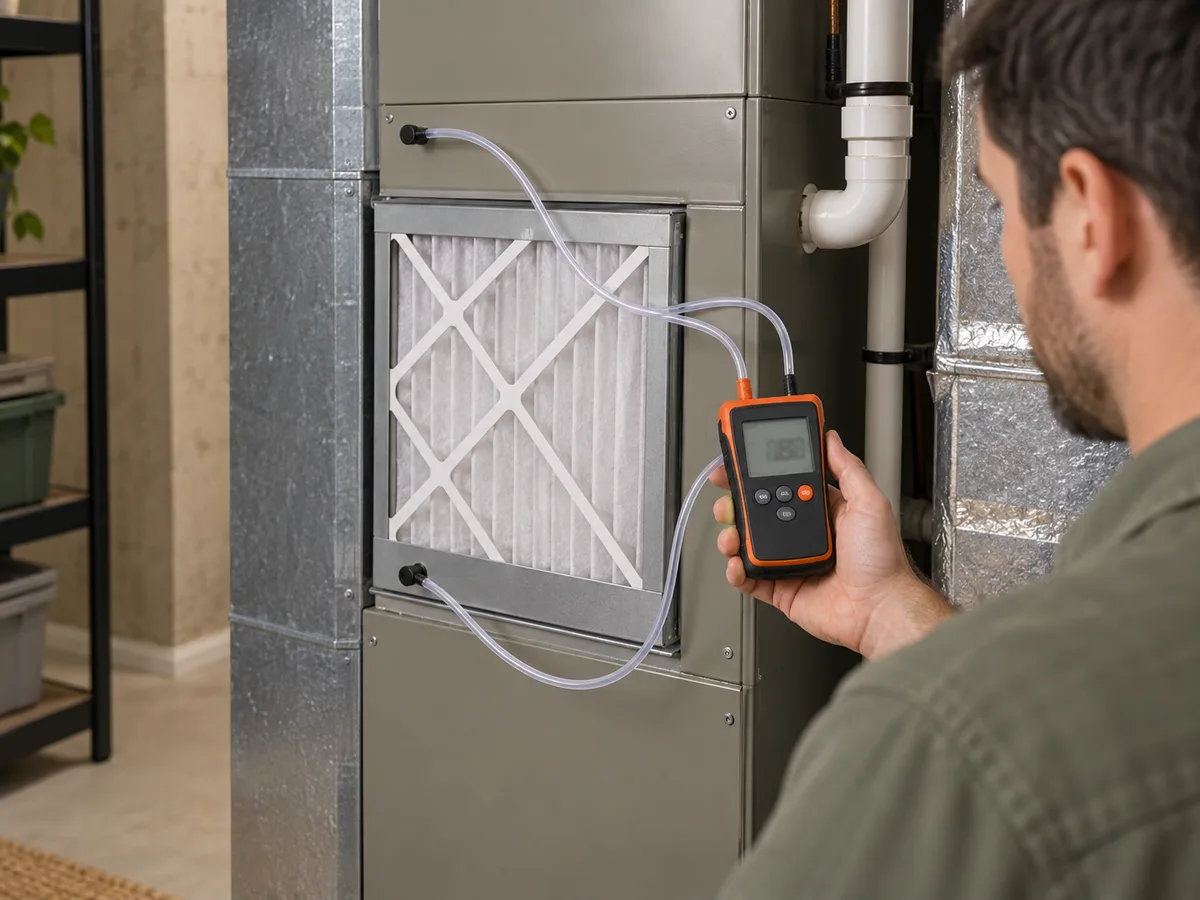
A REPEATABLE METHOD
How to use it
- Check the hose, range and units, keep both ports open to the same air and zero the instrument.
- Connect the high and low ports to identified test points with equal, unkinked tubing and no leaks.
- Run the system at a documented fan speed and allow the reading to stabilize.
- Record pressure, filter model, system mode and date, then compare with the manufacturer limit or a clean-filter baseline.
- Disconnect carefully, cap permanent test ports and repeat using the same hose arrangement next time.
INTERPRET THE MEASUREMENT
How to read the result
- The sign shows which port is at higher pressure; reversed hoses usually reverse the sign, not the magnitude.
- Filter pressure drop rises with loading but also changes with airflow, so comparisons require the same operating mode.
- Pascals, inches of water column and millibars differ greatly; always record the unit.
TROUBLESHOOT THE METHOD
Common problems and what to check
Problem
The zero drifts before connection.
What to do
Let the meter acclimatize, shield it from drafts, inspect tubing and zero again with both ports at the same pressure.
Problem
The filter drop looks lower when it is dirtier.
What to do
Check fan speed, bypass around the filter, blocked return paths and hose placement. Reduced airflow can reduce measured drop.
Problem
The reading pulses rapidly.
What to do
Use time averaging or a damping setting and check that the probe is not in strongly turbulent flow.
STOP BEFORE THE HAZARD
Safety boundary
- Use proper test ports and keep hoses, clothing and tools away from fans, belts and electrical compartments.
- Do not drill into equipment until hidden coils, wiring, refrigerant lines and manufacturer instructions are checked.
- Combustion appliances and pressure-critical rooms require trained assessment under local rules.
SMART BUYING GUIDE
What to look for when choosing
- Choose a low-pressure range and resolution appropriate to residential filters and duct systems.
- Zeroing, averaging and a bidirectional display matter more than a very high maximum range.
- For airflow work, pay for compatible probes and a documented conversion method rather than a generic calculation.
Types of tool
Best for: Filter drop and room-pressure spot checks.
Best for: Tracking cycling systems and pressure changes over time.
Best for: Trained duct testing with compatible pitot or flow devices.
Common functions
Bidirectional pressureZero and relative modesTime averagingMultiple pressure unitsData logging
Worth paying more for
- Good low-range resolution and zero stability
- Leak-resistant fittings and useful averaging
- Logging for variable systems
Usually not worth the extra cost
- Industrial maximum pressure for household ducts
- Automatic airflow values without a defined probe
- Many units when the basic sensor is unstable