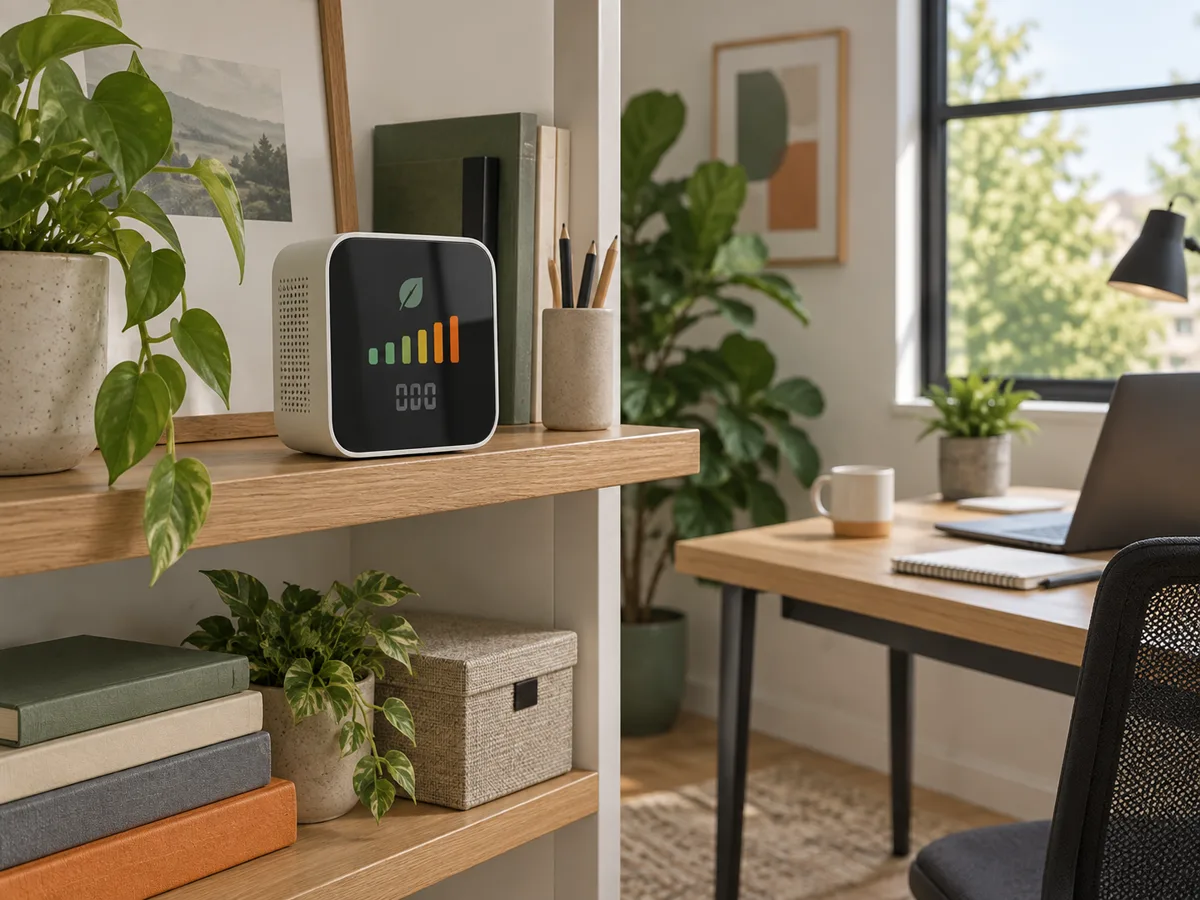
A REPEATABLE METHOD
How to use it
- Confirm the sensor type, calibration state and warm-up requirement; compare it outdoors or with a trusted reference when practical.
- Place it in the occupied breathing zone away from an open window, supply grille, direct sunlight and a person’s immediate exhaled breath.
- Record the room, occupancy, door and window position and ventilation setting, then watch the trend for a full occupied period.
- Change one condition—such as opening a window or increasing mechanical ventilation—and compare the rate of response.
- Repeat on representative days and use the pattern to improve ventilation without ignoring comfort, energy and local requirements.
INTERPRET THE MEASUREMENT
How to read the result
- Outdoor background varies by location; indoor interpretation is stronger when compared with the current outdoor value and occupancy.
- A rising occupied-room trend suggests ventilation is not keeping pace with people, while a falling trend shows dilution or reduced occupancy.
- VOC and “air quality” indexes on low-cost devices may be broad estimates; particles, humidity, CO and radon need appropriate sensors.
TROUBLESHOOT THE METHOD
Common problems and what to check
Problem
The reading is implausibly low in a crowded room.
What to do
Check for automatic baseline calibration, recent outdoor exposure, warm-up and placement in direct supply air. Compare with a known NDIR monitor.
Problem
The value spikes when someone stands near the device.
What to do
Move it away from direct exhaled breath and evaluate a longer room trend rather than a brief local plume.
Problem
Two monitors disagree.
What to do
Place them together, allow stabilization and compare calibration method and sensor type. Consumer accuracy does not imply identical readings.
STOP BEFORE THE HAZARD
Safety boundary
- Do not use this instrument in place of certified carbon-monoxide, smoke or combustible-gas alarms.
- A comfortable CO₂ value does not prove that particles, radon, VOCs, mold or combustion products are safe.
- Investigate suspected combustion spillage or acute symptoms immediately with the correct safety response and qualified help.
SMART BUYING GUIDE
What to look for when choosing
- Prefer a specified NDIR CO₂ sensor; vague “eCO₂” values derived from VOC sensors are not direct CO₂ measurements.
- Useful features include manual calibration, readable trend history, quiet operation and data export at a sensible interval.
- Only pay for particle, VOC or radon channels when the device states the sensor method, range and maintenance needs.
Types of tool
Best for: Spot checks and visible feedback in one occupied room.
Best for: Comparing rooms, schedules and ventilation changes over time.
Best for: Tracking several pollutants when each sensor is properly specified.
Common functions
NDIR CO₂ measurementTrend graph and loggingManual or outdoor calibrationTemperature and humidityParticle or VOC channels
Worth paying more for
- A genuine specified NDIR sensor
- Accessible calibration and exportable history
- Replaceable or serviceable sensors for long-term use
Usually not worth the extra cost
- Unspecified “air score” algorithms
- Decorative color displays without trend history
- eCO₂ marketed as direct carbon-dioxide measurement