A REPEATABLE METHOD
How to use it
- First confirm that the product permits the proposed batch size and partial-pack mixing. Copy the exact recipe and whether it uses mass or volume. A water-per-bag calculation is not permission to split a preblended product.
- Select capacity for container plus contents, and check readability, specified accuracy and minimum useful quantity for the task. Put the scale on a firm level support, protected from drafts and vibration; follow warm-up and checking instructions for the exact model.
- Check zero with the empty platform. Place the clean empty container centrally, let the reading settle, record its mass and tare it as instructed. Taring removes the displayed container contribution, not its load on the scale.
- Add the permitted material carefully and read the stable net mass in the intended unit. Record the result before any further taring. Do not rely on very slow additions if the model’s zero tracking can suppress them; follow its dosing instructions.
- Remove the container, retain the net-mass and unit record, and clean as instructed. Check for spills or abnormal readings. A repeated reading of the same object tests repeatability only; use appropriate reference weights and service for an accuracy check.
INTERPRET THE MEASUREMENT
How to read the result
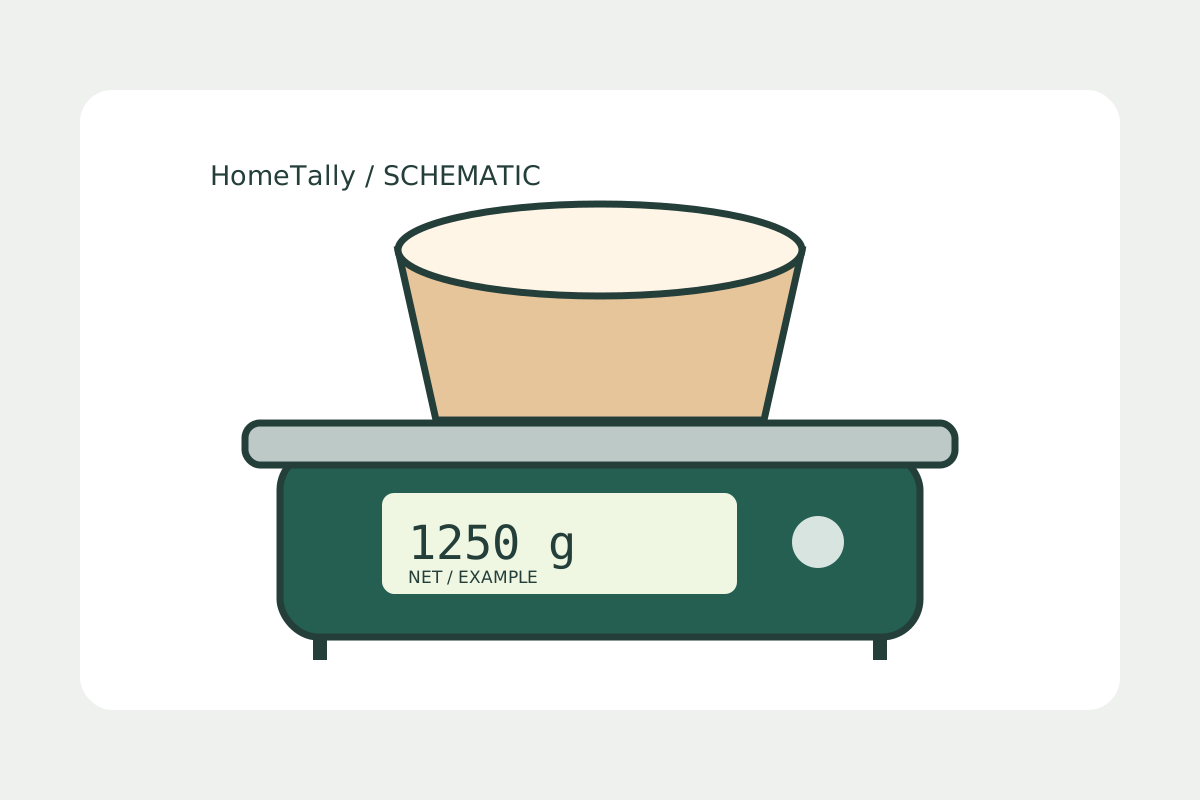
- Fictional example: empty container 350 g, gross loaded mass 1600 g, net material 1250 g = 1.250 kg. The illustration shows the net value, not a 1250 g gross load.
- For a scale marked Max 2000 g, that fictional container plus material occupy 1600 g, leaving 400 g capacity. Pressing tare again does not restore 2000 g of physical capacity.
- A 1 g display increment is 0.1% of a 1000 g batch but 10% of a 10 g addition. These are increment-to-mass ratios, not accuracy specifications or acceptable recipe tolerances; a coarse scale may be unsuitable for the smaller addition.
- Record scale model/ID, check status, maximum load, displayed increment, container mass, tare action, stable net mass/unit, product identity and recipe reference. Do not silently round a required small dose to a whole gram.
TROUBLESHOOT THE METHOD
Common problems and what to check
The reading drifts or never settles.
Stop dosing. Check support, drafts, contact with surrounding objects, power and the manual’s environmental conditions. Do not average a drifting display and call it accurate.
An overload or unexpected negative value appears.
Remove the load safely and consult the model instructions. A negative value after removing a tared container can be normal; an overload must not be solved by pressing tare.
A small addition is below useful readability.
Use a suitable finer scale or a manufacturer-approved larger batch. Do not change the recipe or make an unsafe batch merely to suit the available instrument.
STOP BEFORE THE HAZARD
Safety boundary
- Do not weigh hot, reactive or hazardous materials on an ordinary unapproved scale. Follow product safety information and keep liquids away from electrical parts.
- Do not use a food scale or food container for construction chemicals and then return it to food use.
- Do not exceed gross capacity, drop a heavy container on the platform or mix with a powered tool while the container is on the scale.
SMART BUYING GUIDE
What to look for when choosing
- Allow capacity for the heaviest container and contents together.
- Check useful small-load performance, not only the number of display digits.
- Choose a platform size, cleanable surface and permitted environment suitable for the actual containers.
Types of tool
Best for: Smaller permitted quantities within its capacity and documented performance.
Best for: Heavier containers where its coarser increment still suits the required measurement.
Common functions
Worth paying more for
- Suitable capacity and small-load performance with accessible checking instructions.
- Stable platform, readable units and compatible cleanable surfaces.
Usually not worth the extra cost
- High capacity at the expense of an unusably coarse increment.
- Unneeded wireless logging instead of a trustworthy measurement and record.
Sources & instructions
Original schematic with a fictional reading, not a photograph, calibration reference or approved mixing setup.
Put the measurements to work
Turn a site sketch into reviewable quantities without hiding thickness, product consumption or cutting allowance.
Prepare a traceable two-component batch recordRead a supplied mass ratio, separate net mass from tare and check the arithmetic without inventing a recipe or assuming a larger batch is safe.