Flow is collected volume divided by collection time. A repeatable outlet observation can supply a calculation input, but it does not certify the whole water system.
Choose a safe, observable outlet
Use an accessible cold-water outlet, a clean stable graduated container and a timer. Keep the floor dry, avoid electrical equipment and do not lift a dangerously heavy full bucket. Stop if water is hot, access is unsafe or the stream cannot be captured without splashing or overflow. Do not disconnect pipework, adjust pressure controls or remove fittings for this observation.
Record the outlet, handle setting, spray mode, any attached hose and other water uses. Keep those conditions unchanged when comparing trials. An installed aerator is part of that outlet condition; a nameplate rating and a household observation are not the same test.
Capture the same volume and time interval
EPA’s US WaterSense manual illustrates collection with a container and stopwatch. That verification example is a source for the observation method, not a local legal limit or a claim that this home test earns certification.
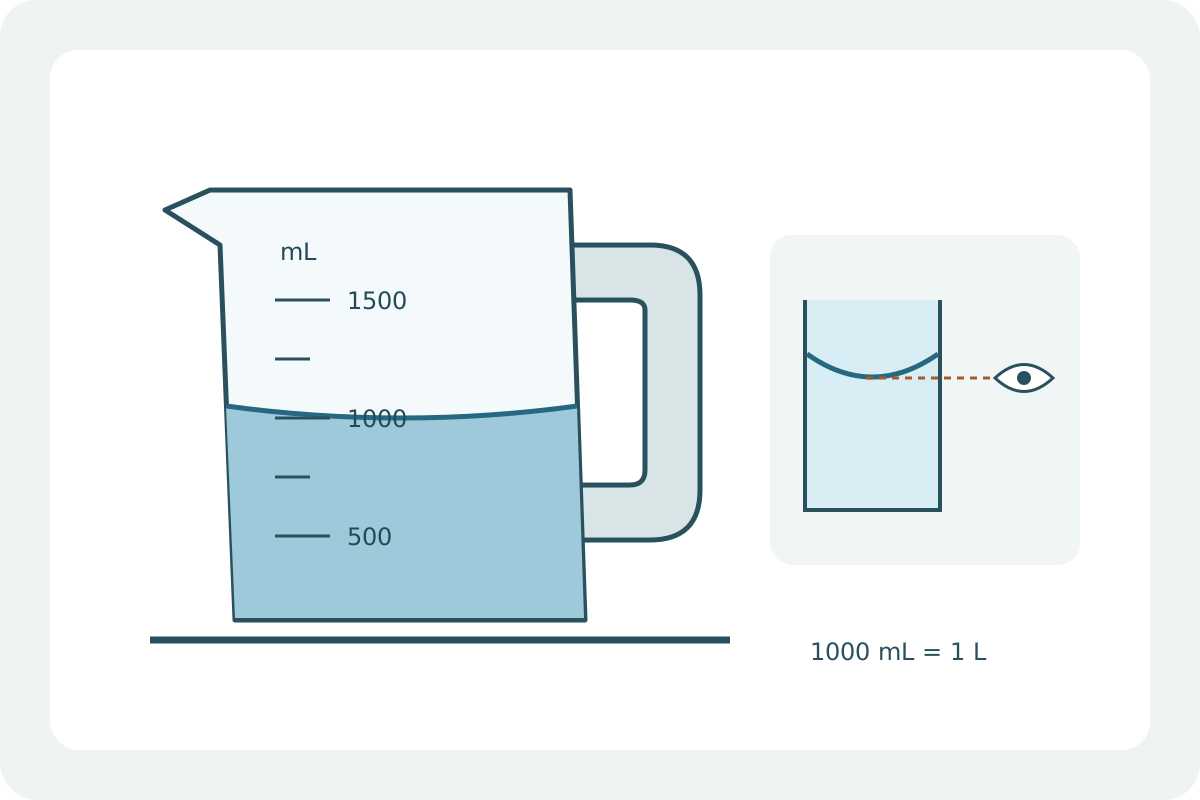
Start with an empty container or subtract a documented initial volume. After establishing a safely collectable steady stream, time exactly the water entering the container. Read the graduations on a level surface. If water misses the container, the timer starts late or the bucket overflows, retain the reason and repeat; do not correct it by guessing.
US EPA WaterSense Technical Reference Manual, Kitchen Faucets (English PDF; US verification example, not local certification) ↗Repeat without hiding changing conditions
Fictional trials collecting 6 L in 30, 32 and 28 s give 12.00, 11.25 and 12.86 L/min. Preserve each trial and condition. The range describes these observations, not an accuracy specification or a guaranteed future flow.
If trials represent the same condition and complete disjoint collection intervals, their combined average is 60 × total litres / total seconds: 60 × 18 / 90 = 12 L/min. The unweighted mean of their three rates is about 12.04 L/min, not that time-weighted result. If a pump cycles or another tap opens, label separate conditions rather than pool them.
Use the result within its boundary
The calculator uses one interval. For 6 L in 30 s, V/t = 0.2 L/s, 12 L/min and 720 L/h. Decimal output cannot improve container graduations or human timing. Very short trials magnify start/stop error; select a manageable volume and repeat without flooding or waste.
This is not pressure, water quality, a leak diagnosis or sustainable well yield. For a fill-time estimate, outlet flow is only a candidate inflow if the actual destination and operating conditions match; simultaneous demand still matters. A hose, different elevation or other active outlets can change delivery. Persistent unexplained variation needs a suitable professional check, not a larger invented design flow.
A record another person can check
| Record | Why it matters | Reject or separate |
|---|---|---|
| Outlet and mode | Location, handle setting, hose and aerator | Different configurations |
| Water volume | Actual collected L and container graduations | Nominal capacity or spilled water |
| Elapsed interval | Actual seconds, same capture window | Untimed startup or overflow |
| Each repeat | Volume, time, other uses and pump behaviour | Changing conditions pooled together |
Worked example
An illustrative observation, not a flow target
A complete 6 L cold-water capture takes 30 s under one documented outlet condition. The figures are fictional, not an efficiency target or a product rating.
Qs = 6 / 30 = 0.2 L/s
Qmin = 60 × 6 / 30 = 12 L/min
Qh = 3600 × 6 / 30 = 720 L/h
The same observation is 12 L/min, 0.2 L/s or 720 L/h. Preserve the record and its conditions; do not label it pressure or a guaranteed system capacity.
What to have ready
- Accessible cold-water outlet and stable container
- Actual collected volume, not bucket capacity
- Same capture and timing interval in seconds
- At least several documented repeats where practical
- Outlet settings, other uses and rejected trials retained
Common mistakes
- Entering mL as L or stopwatch 00:30 as 0.30 min.
- Using container capacity without measuring the collected water.
- Treating spilled water as collected volume.
- Averaging different conditions or unweighted rates without explanation.
- Calling an outlet average pressure, water safety or sustainable well yield.
Tools for these measurements
Prepare the measurements with these instrument guides.
Use and limitations. Sources include US public agencies. Principles are general; regulations and design values must be checked where you live.Worked examples use stated hypothetical inputs.