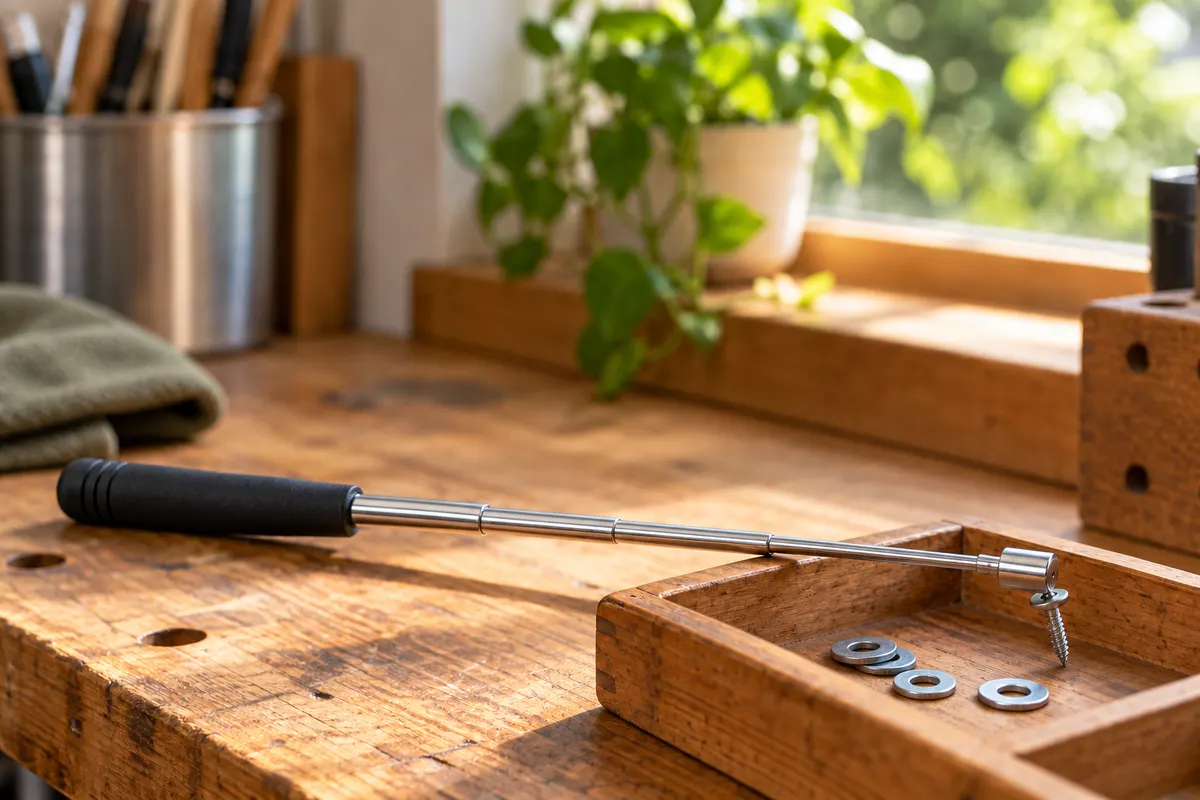
A REPEATABLE METHOD
How to use it
- Find the part visually and decide whether the access path is safe. Stop near energized, hot or moving equipment.
- Check attraction on a similar spare part over a tray; brass, copper, plastic and some stainless steels will not be retrieved magnetically.
- Inspect the tip attachment and extend only as far as needed without forcing the telescopic joints.
- Approach slowly with a clear view, make contact and withdraw gently along the same clear path.
- Place the recovered part in a tray, count missing pieces and inspect it before reuse. Clean the tip and retract for storage.
INTERPRET THE MEASUREMENT
How to read the result
- Manufacturer pickup capacity belongs to a particular model and contact condition; a small curved screw is not a flat test surface.
- Failure to attract a part does not identify its exact alloy or prove a space is empty.
- Magnetic retrieval does not establish that the recovered fastener is the right size or undamaged.
TROUBLESHOOT THE METHOD
Common problems and what to check
The part does not attach
Check a spare part for attraction. Choose a suitable mechanical pickup or obtain safe access instead of forcing the magnet.
The tip sticks to nearby metal
Withdraw gently; shorten the reach or choose a narrower head. Do not lever against the shaft.
The part drops on withdrawal
Reduce obstructions and improve the viewing angle. Do not reach blindly into the opening.
STOP BEFORE THE HAZARD
Safety boundary
- The metal shaft is not electrically insulated. Keep it out of energized enclosures, sockets and unknown concealed service spaces.
- Do not suspend loads, lift equipment or use the shaft as a pry bar; retain control of small recovered parts.
- Keep the magnet away from magnet-sensitive devices and follow their manufacturer’s separation guidance.
- Do not open sealed pressure equipment or reach into moving mechanisms to retrieve a fastener.
SMART BUYING GUIDE
What to look for when choosing
- Match head diameter and retracted length to the real accessible gap; extra reach is not always useful.
- Choose sound telescopic joints and a secure tip. Test with the small parts you actually use.
Types of tool
Best for: Visible small magnetic parts along a clear straight path.
Best for: A suitable accessible curved path, or nonmagnetic parts when using a claw.
Common functions
Worth paying more for
- A securely retained tip, smooth shaft and a head that fits the intended opening.
Usually not worth the extra cost
- Large advertised pickup force for tiny screws, or extra length with poor control.
Sources & instructions
AI-generated topic illustration; do not use the depicted scale for measurements.
Put the measurements to work
Separate measured area, effective product coverage, layout allowance and whole-pack purchasing.
Estimate plaster and drywall from a measured layoutTurn a site sketch into reviewable quantities without hiding thickness, product consumption or cutting allowance.