A REPEATABLE METHOD
How to use it
- Check the mirror, joint and shaft; choose a safe viewing position.
- Set the head angle and extend the shaft only as far as needed.
- Illuminate the target separately and compare the reflection with its surroundings.
- Change the viewing angle to confirm marks or moisture; record the exact location.
- Retract, clean and protect the mirror after use.
INTERPRET THE MEASUREMENT
How to read the result
- Reflections reverse orientation; confirm the target before marking its location.
- A stain may be old residue; one dry observation does not exclude an intermittent leak.
- A mirror cannot establish pipe condition inside a wall or electrical isolation.
TROUBLESHOOT THE METHOD
Common problems and what to check
Problem
Glare obscures the fitting
What to do
Move the light away from the viewing axis and adjust the head angle.
Problem
Image moves or the head drops
What to do
Shorten the reach and check the joint; do not force it against the fitting.
STOP BEFORE THE HAZARD
Safety boundary
- A metal shaft conducts electricity: keep it away from exposed conductors and electrical enclosures.
- Do not reach into running machinery or touch hot equipment; arrange safe isolation first.
- Stop if safe access is unavailable; do not loosen fittings or enter confined spaces to obtain a view.
SMART BUYING GUIDE
What to look for when choosing
- Match mirror-head size to the opening, not just the maximum reach.
- Check joint stability, comfortable handling and replaceable mirror availability.
Types of tool
Best for: Accessible spaces with separate lighting.
Best for: Dark corners where the light does not create glare.
Common functions
Visual checks behind accessible plumbing and cabinet fittings.
Worth paying more for
- A stable adjustable joint and a head that fits the opening.
Usually not worth the extra cost
- Excessive reach that makes the view unstable or lighting that reflects straight back.
Sources & instructions
- Ullman Devices: inspection-mirror types and viewing arrangements
- Ullman Devices: example telescoping mirror and adjustable head
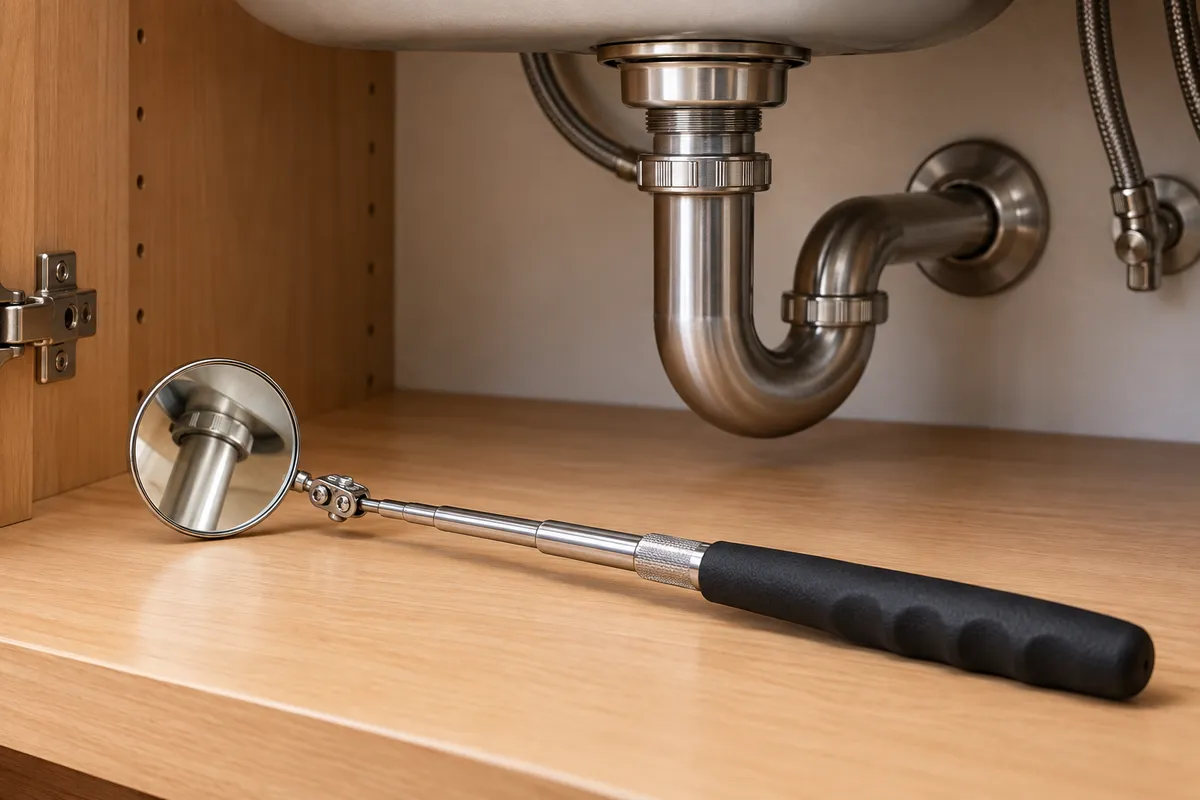
AI-generated topic illustration; do not use the depicted scale for measurements.
Put the measurements to work
Four quick checks for a home water system
Turn pipe dimensions, tank levels, pressure settings and pump run time into four useful commissioning numbers.
Find and quantify a hidden household water leakUse the water meter, simple isolation tests and a timed measurement to turn unexplained consumption into a repairable fault.