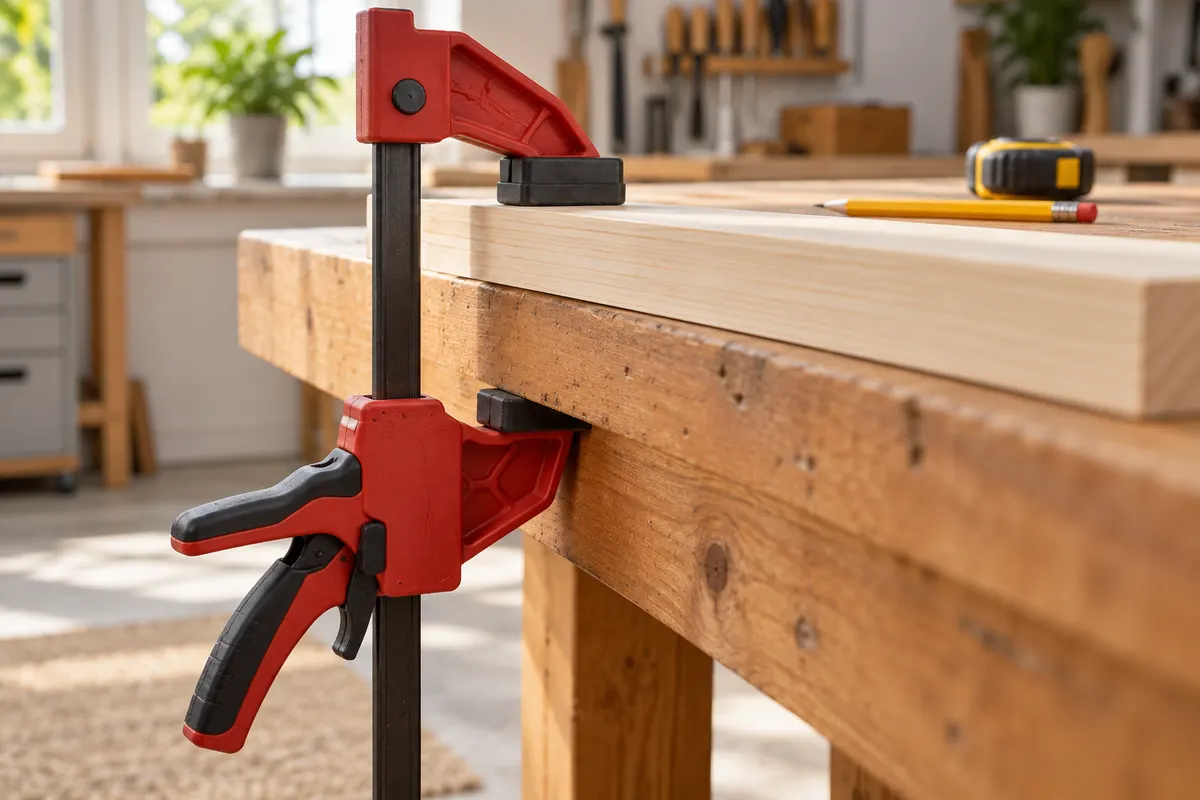
A REPEATABLE METHOD
How to use it
- Support the workpiece on a stable bench. Choose a clamp opening and throat depth that reach the intended contact areas.
- Inspect the rail, jaws and protective pads; remove chips and dried glue from the contact surfaces.
- Position both pads squarely, keep fingers clear and use a suitable protective block on delicate finishes.
- Increase pressure gradually until the workpiece is secure, then verify it has not bowed or moved away from the mark.
- Check stability before the planned operation and keep the clamp clear of its tool path. Support the workpiece before releasing the trigger.
INTERPRET THE MEASUREMENT
How to read the result
- Opening capacity and throat depth are different dimensions; both must fit your arrangement.
- Clamping force is not a permissible lifting load, and more pressure is not automatically better.
- Clamping can shift a joint or bend thin material. Recheck the marking and fit after tightening.
TROUBLESHOOT THE METHOD
Common problems and what to check
The board slips
Stop the operation, check pad seating and bench support, and reposition or use an appropriate additional clamp.
The pads leave dents
Release pressure safely, inspect the finish and use suitable protective blocks with only the pressure needed.
The rail or jaw looks bent
Remove the clamp from use; do not straighten or overload damaged parts.
STOP BEFORE THE HAZARD
Safety boundary
- Keep fingers out of the jaw gap and support the workpiece when releasing pressure.
- Do not use a clamp for lifting, transporting, overhead support or supporting a person.
- Do not add a pipe extension or hammer the handle to increase force; respect the exact model’s instructions.
- Secure the work for each operation and keep pads and rail outside cutting or drilling paths; this guide is not a power-tool operating procedure.
SMART BUYING GUIDE
What to look for when choosing
- Measure opening and throat depth, then check whether the handle can be operated in the planned position.
- Prefer replaceable protective pads and a smooth controlled release; match force and clamp type to the material.
Types of tool
Best for: Quick positioning and light assembly within its specification.
Best for: Slower controlled tightening when that shape suits the work.
Common functions
Worth paying more for
- Sound jaws, reliable release, suitable reach and replaceable pads.
Usually not worth the extra cost
- Excess force or an oversized rail that obstructs a small workspace.
Sources & instructions
AI-generated topic illustration; do not use the depicted scale for measurements.
Put the measurements to work
Separate measured area, effective product coverage, layout allowance and whole-pack purchasing.
Estimate plaster and drywall from a measured layoutTurn a site sketch into reviewable quantities without hiding thickness, product consumption or cutting allowance.