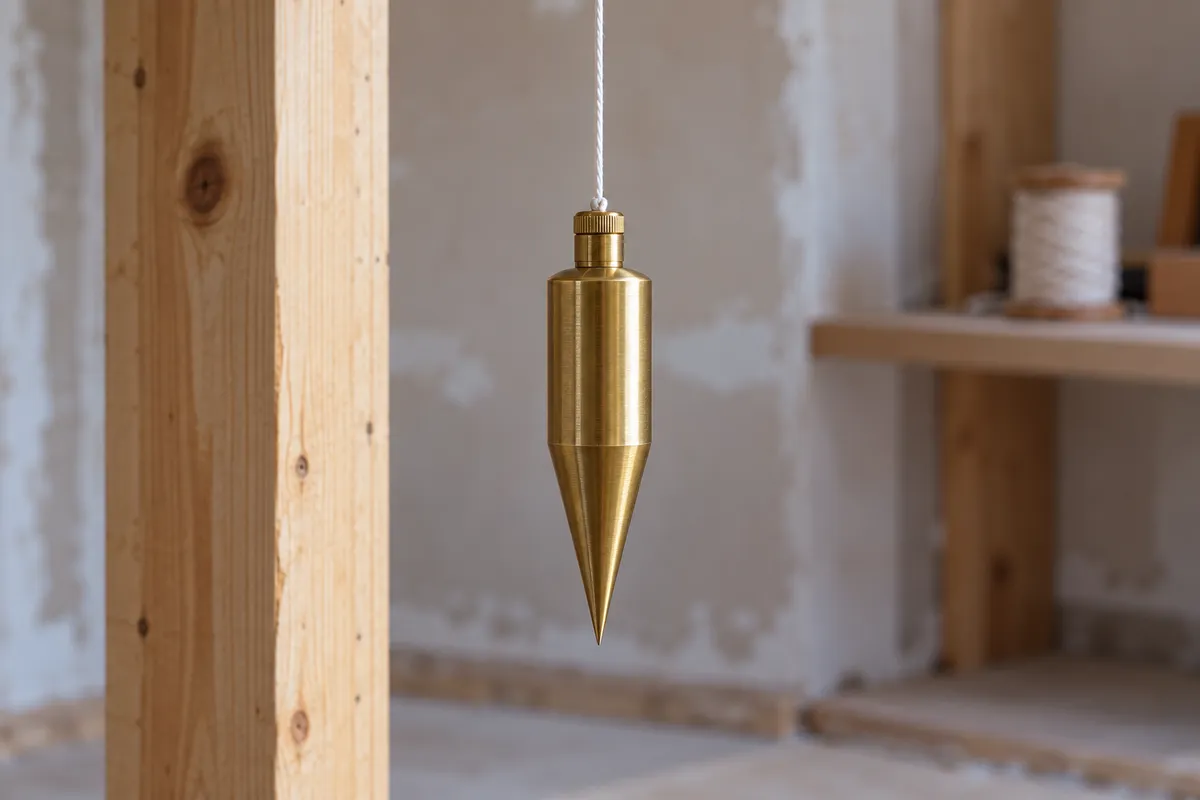
A REPEATABLE METHOD
How to use it
- Inspect the cord, centered attachment and point; choose a secure existing support.
- Hang the bob clear of the surface and floor from a safe working position.
- Wait for motion to settle and shield the line from drafts without touching it.
- Compare the perpendicular gap at several heights, or mark the point below the stationary tip.
- Repeat at another position and record the reference and gaps before adjusting anything.
INTERPRET THE MEASUREMENT
How to read the result
- Equal gaps indicate local vertical alignment only along the checked line.
- Surface bumps can change the gap without representing the whole wall’s lean.
- A rubbing cord, swinging bob or shifted support invalidates the reference.
TROUBLESHOOT THE METHOD
Common problems and what to check
The bob keeps swinging
Reduce drafts, stop nearby vibration and wait; do not hold it against the wall to force a reading.
Results change after rehanging
Check the support, cord attachment, contact and viewpoint; repeat using the same marked reference.
STOP BEFORE THE HAZARD
Safety boundary
- Keep people out from under the suspended weight and protect the sharp point during storage.
- Do not install a fixing into an unknown wall or ceiling; concealed services must be checked first.
- Do not lean from ladders or alter a load-bearing element on the strength of this check alone.
SMART BUYING GUIDE
What to look for when choosing
- Choose a centered attachment, sound cord and a point that is easy to see.
- Match weight and line length to the safe support and working space, rather than choosing the heaviest bob.
Types of tool
Best for: Simple accessible indoor alignment checks.
Best for: Repeated checks with a compatible secure mounting surface.
Common functions
Worth paying more for
- A secure centered attachment, replaceable cord and protective storage.
Usually not worth the extra cost
- Extra weight that does not solve drafts or an unstable support.
Sources & instructions
- Johnson Level: checking vertical alignment with a plumb bob
- STANLEY: central cord attachment and replaceable point
- TAJIMA: plumb-line holders and quick-stabilizing variants
AI-generated topic illustration; do not use the depicted scale for measurements.
Put the measurements to work
Turn drawings and site measurements into transparent quantities without confusing an order estimate with structural or product design.
Estimate plaster and drywall from a measured layoutTurn a site sketch into reviewable quantities without hiding thickness, product consumption or cutting allowance.