A REPEATABLE METHOD
How to use it
- Locate the part with light and, if needed, an inspection mirror. Do not reach into an unknown opening or near energized, moving or hot equipment.
- Inspect the sheath, claw attachment and plunger. Test opening and closing on a similar spare part over a tray before using a narrow gap.
- Check that the closed head, open claws and gripped part can all fit through the intended path. Use only gentle bends allowed by the tool instructions.
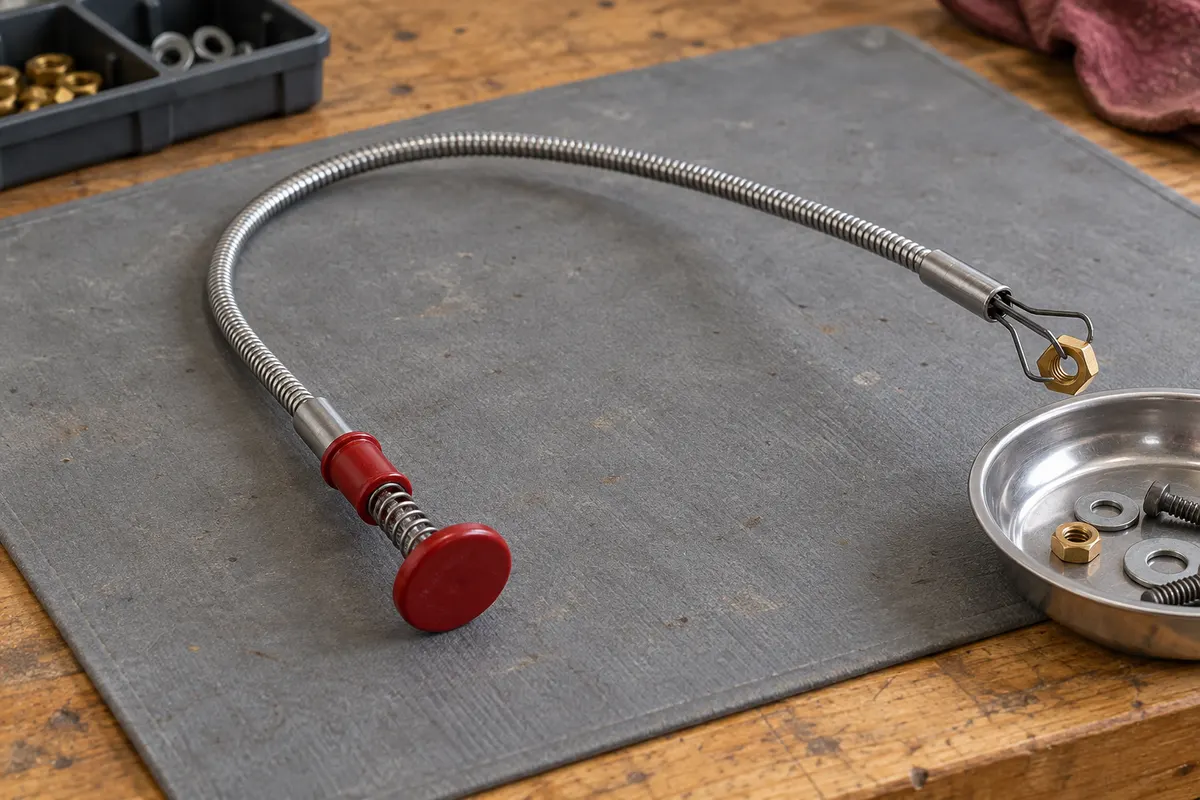
- Approach with a clear view. On a spring-plunger model, press to open the claws around the loose part, then release gradually to grip; follow the exact model’s operation.
- Withdraw slowly along the clear route. Hold the part over a tray before opening the claws, then inspect and count recovered pieces.
INTERPRET THE MEASUREMENT
How to read the result
- The claw grips mechanically rather than relying on magnetic attraction. Whether it holds a particular part depends on shape, size and contact, not simply the material name.
- Shaft length is reach, not permissible load. A mechanical pickup must not be used to suspend equipment or retrieve a heavy component.
- A head that fits into a gap when closed may not fit back out with the part held. Check the withdrawal clearance before attempting retrieval.
TROUBLESHOOT THE METHOD
Common problems and what to check
The part slips from the claws
Improve visibility and contact, and test on a spare part. Obtain safe access if the shape cannot be held securely.
The claws catch an edge
Stop and withdraw gently if possible. Do not pull hard, twist blindly or use the sheath as a lever.
The plunger does not return smoothly
Remove the tool from use and follow its maintenance instructions. Do not force a damaged spring or continue inside the gap.
STOP BEFORE THE HAZARD
Safety boundary
- The metal sheath and claws are not electrically insulated. Keep them out of sockets, live equipment and unknown service cavities.
- Use only for loose small parts in safely accessible areas. Do not enter tanks or pits, reach into moving mechanisms or open sealed pressure equipment.
- Keep fingers clear of the claws and maintain control over the recovered part. Never use the pickup for lifting, overhead support or supporting a person.
- Do not force the tool into a drain or sharp bend; it may snag or break. A dropped part inside unsafe equipment requires appropriate isolation and competent service.
SMART BUYING GUIDE
What to look for when choosing
- Match the head diameter, opening and shaft reach to the actual part and the clear path out, not only the depth of the gap.
- Prefer smooth controlled plunger action, firmly attached claws and a sheath that follows the intended route without sharp bends.
Types of tool
Best for: A small loose nonmagnetic part that the jaws can surround in a visible accessible gap.
Best for: A small magnetically attracted part along a suitable clear path; it is not interchangeable with the claw.
Common functions
Worth paying more for
- A securely attached head, smooth spring action and a head size that allows safe withdrawal.
Usually not worth the extra cost
- Excessive reach that reduces control, or a combined magnet when the parts you need to retrieve are nonmagnetic.
Sources & instructions
AI-generated topic illustration; do not use the depicted scale for measurements.
Put the measurements to work
Separate measured area, effective product coverage, layout allowance and whole-pack purchasing.
Estimate plaster and drywall from a measured layoutTurn a site sketch into reviewable quantities without hiding thickness, product consumption or cutting allowance.