A REPEATABLE METHOD
How to use it
- Choose a surface, pipe-clamp, immersion or air probe for the actual task. Confirm sensor type, connector compatibility and temperature limits.
- Inspect the cable and tip. Check the meter with the manufacturer’s recommended reference method before relying on critical comparisons.
- For a pipe surface, use a suitable contact probe on a safely accessible clean point with repeatable pressure; never puncture insulation or pipework blindly.
- Keep contact stable and wait for the reading to settle. Record location, units, probe type and operating state.
- For supply/return comparisons, use comparable contact conditions and note changes in operating state. Two channels can reduce timing differences but may have offsets.
INTERPRET THE MEASUREMENT
How to read the result
- A probe on the outside of a pipe reads the pipe surface, not directly the moving water inside.
- If two comparable surface observations are 45 °C and 38 °C, their observed difference is 7 K. Do not automatically use it as the fluid temperature difference for a flow calculation.
- The useful range and uncertainty belong to the complete meter-and-probe combination. Display resolution alone is not accuracy.
TROUBLESHOOT THE METHOD
Common problems and what to check
The reading drifts with hand pressure.
Review contact area and stability; use the proper surface or pipe-clamp probe instead of a pointed immersion probe held against metal.
A reflective pipe gives different infrared and contact readings.
Check emissivity and reflected surroundings for infrared measurements, and contact quality for the probe. Neither result is automatically correct.
Two channels disagree at the same reference point.
Check probe compatibility and channel offsets; seek the specified calibration service rather than adjusting by guesswork.
STOP BEFORE THE HAZARD
Safety boundary
- Avoid burns and moving equipment; measure only safely accessible surfaces within probe limits.
- A metal temperature probe is not insulated electrical test equipment. Keep it away from live parts.
- Do not open pressurized heating systems or remove guarded covers to insert a probe. Liquid measurements require a suitable safe access point.
SMART BUYING GUIDE
What to look for when choosing
- Buy the probe shape needed for the task, not just the widest advertised meter range.
- Check combined accuracy, response characteristics and replacement-probe availability.
Types of tool
Best for: Repeatable contact checks on accessible pipework and surfaces.
Best for: Liquids at a suitable safe access point; not automatically a good surface probe.
Common functions
Worth paying more for
- A suitable probe and documented uncertainty
- Dual channels when comparison timing matters
Usually not worth the extra cost
- Extreme temperature ranges outside your work
- Extra decimal places without a better probe or stated accuracy
Sources & instructions
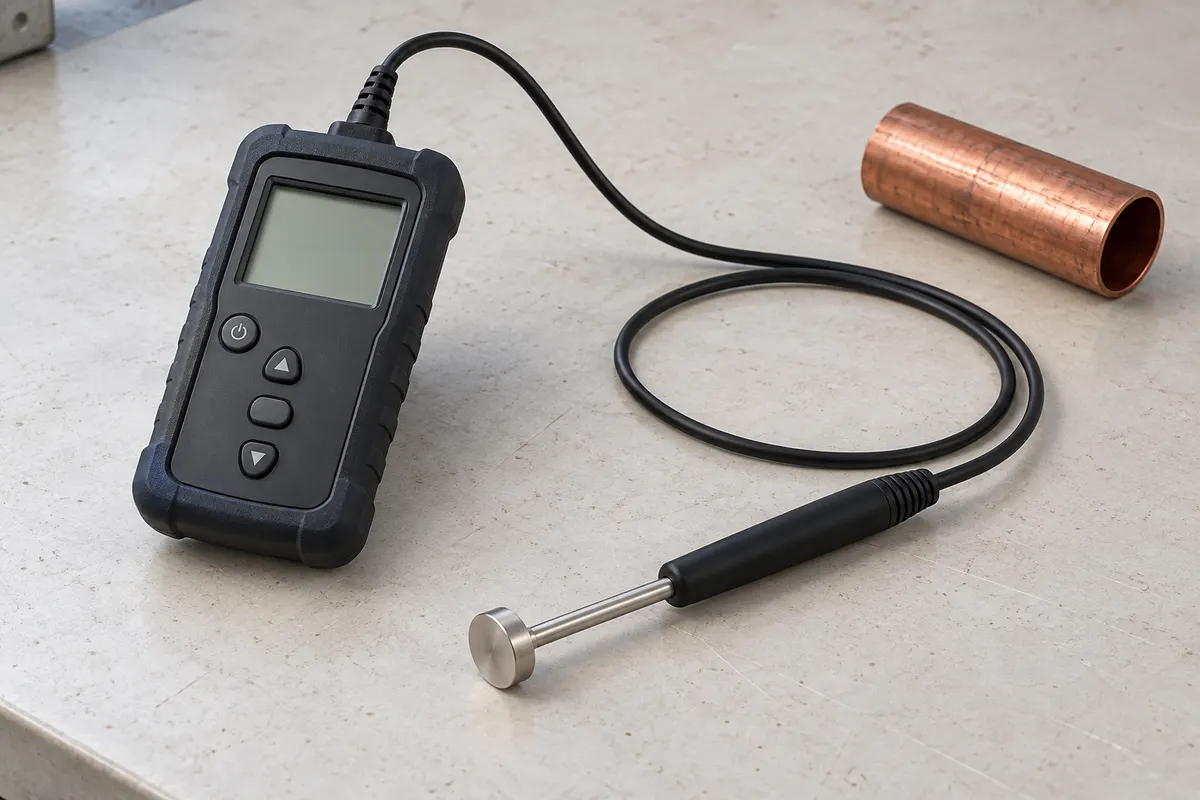
AI-generated topic illustration; do not use the depicted scale for measurements.
Put the measurements to work
Estimate heating energy, then account for peak demand, recovery, storage and safety.
Size a heat pump from the building load and cold-weather capacityCompare load and equipment at matching temperatures, plan auxiliary heat and test the installed system.
Plan a low-temperature hydronic heating circuitConnect room heat loss, emitter output, water flow, pump head and commissioning without treating one number as the whole design.