A REPEATABLE METHOD
How to use it
- Find the coating’s specified wet-film thickness and checking method. Choose a clean comb with the right units, range and graduation spacing.
- Use a stable accessible test location and check immediately after application, before the film starts to set. Avoid treating a rough or curved substrate as a flat reference.
- Place the selected edge perpendicular to the surface, evenly, until its two outer datum feet contact the substrate. Do not drag it through the coating.
- Lift straight out and identify the last wetted tooth and the next dry tooth. Record both marks, location, coating and application time; report as required by the specified method.
- Clean using the product-compatible method, repeat at separate representative locations and repair the disturbed spots as the coating instructions permit.
INTERPRET THE MEASUREMENT
How to read the result
- Example: the 100 µm tooth is wet and the next 125 µm tooth is dry. Record a bracket of approximately 100–125 µm, not an exact 112.5 µm measurement. A prescribed standard may use a different reporting convention.
- All teeth wet or all teeth dry means no usable bracket on that edge. Check contact, timing and range; do not report the end of the scale as the measured thickness.
- Wet thickness is not cured thickness. Any dry-film estimate needs the coating’s volume-solids information and applicable dilution assumptions; verify cured thickness separately if required.
- The paint quantity calculator estimates a purchase amount from area and stated coverage. It cannot certify that a correctly thick coat was applied.
Work through an example
Illustrative situations and readings, not product tolerances. Follow the instructions for your own tool.
A bracket crossing the target cannot certify a passOpen the worked exampleClose the worked example
In this fictional example only, a coating instruction requires at least 110 µm wet-film thickness. Check a fresh patch with a comb that has 100 and 125 µm teeth.
Before the reading
- Read the actual product target; 110 µm is not a universal recommendation.
- Check clean teeth and full datum-foot contact on a suitable flat patch.
- Check immediately and record the wet and dry marks separately.
Example notes
- Last wetted tooth
- 100 µm
- Next dry tooth
- 125 µm
- Fictional product minimum
- 110 µm
What this tells you
The approximately 100–125 µm bracket straddles 110 µm: it permits both a below-target and an above-target value. Taking the midpoint 112.5 µm does not establish that this patch meets the minimum.
Your next step
Follow the required checking method and use suitable graduation spacing to resolve the question. Check other locations independently and correct only within the coating instructions.
Do not conclude: Do not write “passes, 112.5 µm” or substitute a cured-film requirement for the wet-film target.
Method reference: Elcometer: wet-film comb interpretation
TROUBLESHOOT THE METHOD
Common problems and what to check
The teeth smear rather than show a clear transition
Repeat promptly with a clean edge and straight placement on a suitable new spot. A partly set coating is not a valid substitute for a fresh wet-film check.
Different locations show different brackets
Keep the location records. Check application consistency and substrate shape; do not hide thin spots by averaging away the variation.
The target lies outside the comb range
Select a suitable range and readable graduation spacing. Do not extrapolate from an all-wet or all-dry edge.
STOP BEFORE THE HAZARD
Safety boundary
- Follow the coating and cleaner safety data sheets for ventilation, gloves and eye protection; a comb does not make a solvent-based job safe.
- Keep sharp metal edges away from fingers and finished fixtures; measure from a stable position, not by reaching from an unsafe ladder.
- Collect coating residues and cleaning waste as required by the product and local rules; do not wash unknown solvents into a drain.
SMART BUYING GUIDE
What to look for when choosing
- Match the target wet-film interval and required checking method, not simply the widest advertised range.
- Look for readable units, undamaged stepped teeth and trustworthy graduation information. A decorative unmarked comb is not a measuring instrument.
Types of tool
Best for: Repeated checks when it can be cleaned without damaging its edges.
Best for: A product-compatible single-use check with a suitable marked range.
Common functions
Worth paying more for
- A suitable verified range and clear graduations.
- Durable edges and a protective case for repeated use.
Usually not worth the extra cost
- A claimed dry-film result without the required material information.
- Extra scale ranges that do not cover your specified coating check.
Sources & instructions
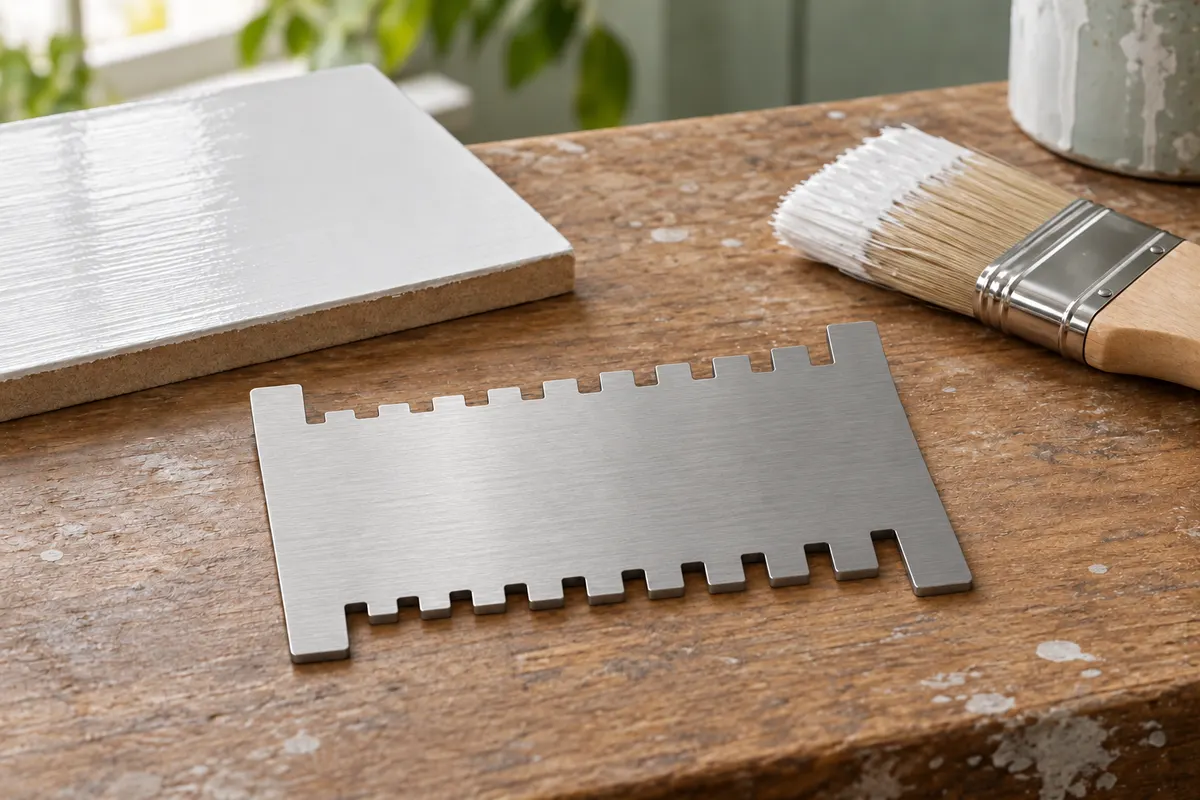
AI-generated topic illustration; do not use the depicted scale for measurements.