A REPEATABLE METHOD
How to use it
- Identify the reference faces and the side of the joint you are copying; label the waste side on a trial piece.
- Clean the contact faces and inspect the stock and blade for damage or looseness.
- Loosen the lock, seat the stock against one face and move the blade into contact with the other without forcing it.
- Tighten the lock while holding contact. Lift and reseat the tool to check that locking has not changed the angle.
- Transfer to a supported offcut using the same reference face. Test the mating pieces before marking the final material.
INTERPRET THE MEASUREMENT
How to read the result
- A copied inside angle and its outside supplementary angle are different; record which face was used.
- An irregular wall may have different angles at different heights. One sample cannot define every joint.
- Do not enter an assumed degree value into a calculator. Use a suitable angle measuring instrument if a number is needed.
TROUBLESHOOT THE METHOD
Common problems and what to check
Problem
Angle changes while marking
What to do
Check the lock and blade clearance. Replace a tool that cannot hold its setting.
Problem
Trial pieces do not meet
What to do
Check reference faces, orientation and how the joint divides the angle. Do not repeatedly trim the final piece by guessing.
Problem
Stock rocks on the reference
What to do
Remove debris or choose a sound reference section. A short uneven contact produces an unreliable copy.
STOP BEFORE THE HAZARD
Safety boundary
- Keep fingers away from sharp blade edges; fold the blade for storage.
- Mark and test on a supported workpiece; never adjust a running saw using this tool.
- The bevel checks geometry only, not a structural connection or the safe setup of a cutting machine.
SMART BUYING GUIDE
What to look for when choosing
- Look for a lock that holds without shifting the blade.
- Check stock length and blade travel against the corners you need to reach.
Types of tool
Best for: Reference contact where a side nut would interfere.
Best for: General transfers with enough clearance around the nut.
Common functions
Copying non-square corners.Checking an offcut against a retained angle.
Worth paying more for
- Flat reference faces and a reliable lock.
- A blade that moves smoothly without sideways play.
Usually not worth the extra cost
- Unmarked blades advertised as precise degree meters.
- A very long blade that cannot fit the actual corner.
Sources & instructions
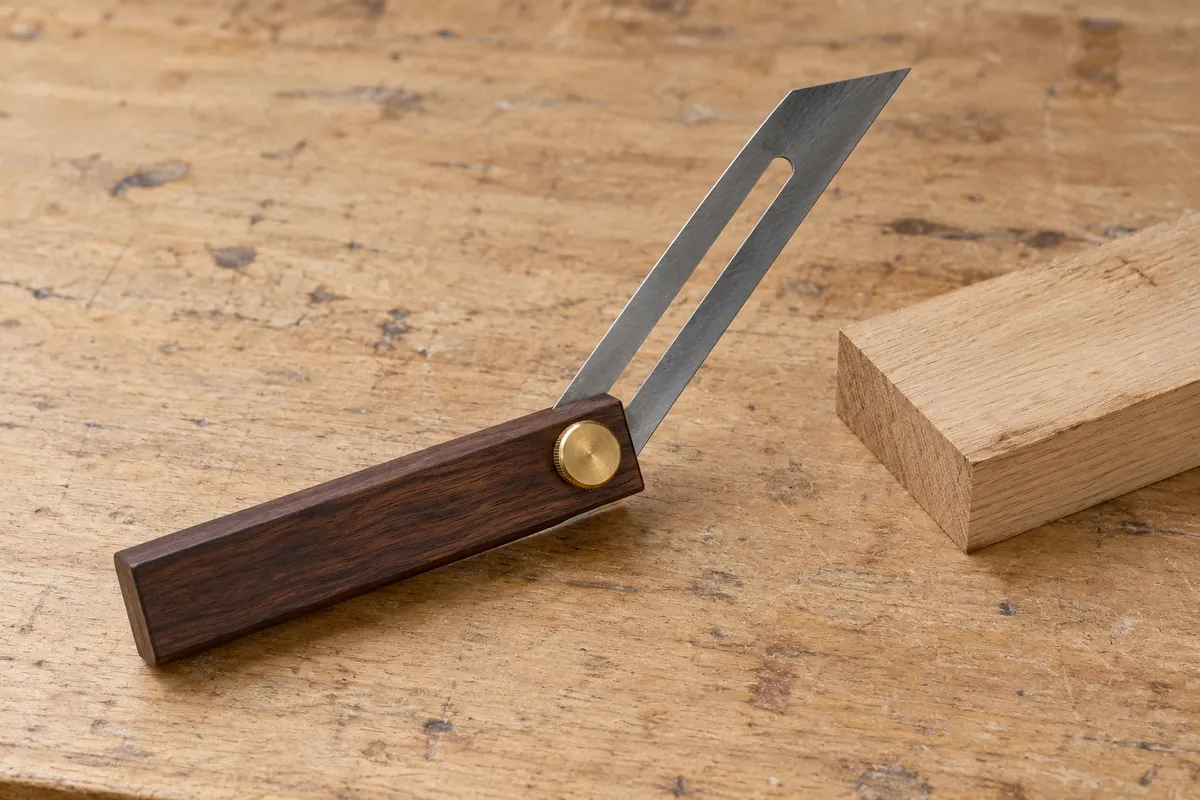
AI-generated topic illustration; do not use the depicted scale for measurements.