A REPEATABLE METHOD
How to use it
- Choose a dry indoor location and an appliance that is compatible with the meter’s voltage, plug, current and permitted load type. Inspect both plugs and the socket.
- With the appliance switched off, connect it through the meter as its manual specifies. Do not open equipment or alter wiring.
- Record the initial energy counter and time, or reset them using the model-specific procedure.
- Run a representative normal cycle. For cycling loads such as a refrigerator, a momentary observation is not representative of the day.
- Record final kWh, elapsed time and operating conditions. Use the difference between counters if they were not reset.
INTERPRET THE MEASUREMENT
How to read the result
- W describes power at that moment; kWh describes accumulated energy. VA, when available, is apparent power rather than active watts.
- A measured increase of 0.72 kWh over 24 hours corresponds to 720 Wh/day for that observation. It is not a promise of identical seasonal consumption.
- Transfer observed daily Wh to the energy budget. Keep appliance-side measurements separate from inverter losses and battery reserve.
TROUBLESHOOT THE METHOD
Common problems and what to check
Problem
The instantaneous reading keeps changing.
What to do
Check whether the appliance cycles or changes operating mode; compare complete cycles using accumulated energy.
Problem
Standby consumption looks like zero.
What to do
Check the meter’s resolution and low-power accuracy; do not interpret an unresolved reading as proof of no consumption.
Problem
The meter or plug becomes hot, smells unusual or is damaged.
What to do
Stop use safely and have the appliance/socket assessed. Never work around a rating or protection limit.
STOP BEFORE THE HAZARD
Safety boundary
- Never exceed any marked voltage, current, power or permitted-load limit. A matching plug does not establish compatibility.
- Do not use a household plug-in meter for hardwired equipment, wet locations or improvised adapters; use a qualified electrician for those cases.
- Do not interrupt essential medical equipment, freeze protection or other critical loads merely to obtain a reading.
SMART BUYING GUIDE
What to look for when choosing
- Choose a locally compatible, appropriately rated meter with clear energy and elapsed-time displays.
- For low standby loads, check published low-power accuracy, not just the number of display digits.
Types of tool
Best for: A repeatable appliance energy check without an account or network.
Best for: Reviewing changes across operating periods; check data retention and access.
Common functions
Active power and accumulated energyElapsed observation timeOptional power factor and apparent powerOptional local logging
Worth paying more for
- Documented accuracy for the loads you actually measure
- Readable counters and reliable data retention
Usually not worth the extra cost
- Cloud features for an occasional local reading
- Unverified peak-current claims as a substitute for a proper surge assessment
Sources & instructions
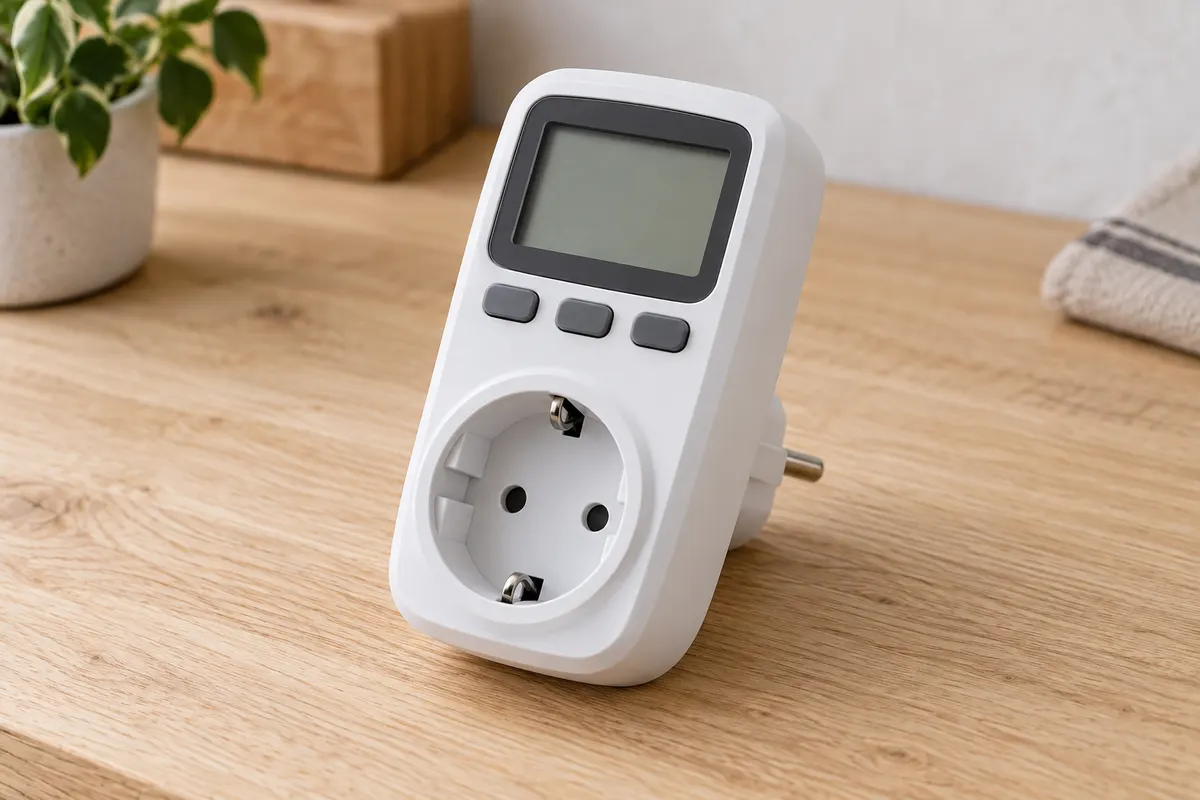
AI-generated topic illustration; do not use the depicted scale for measurements.