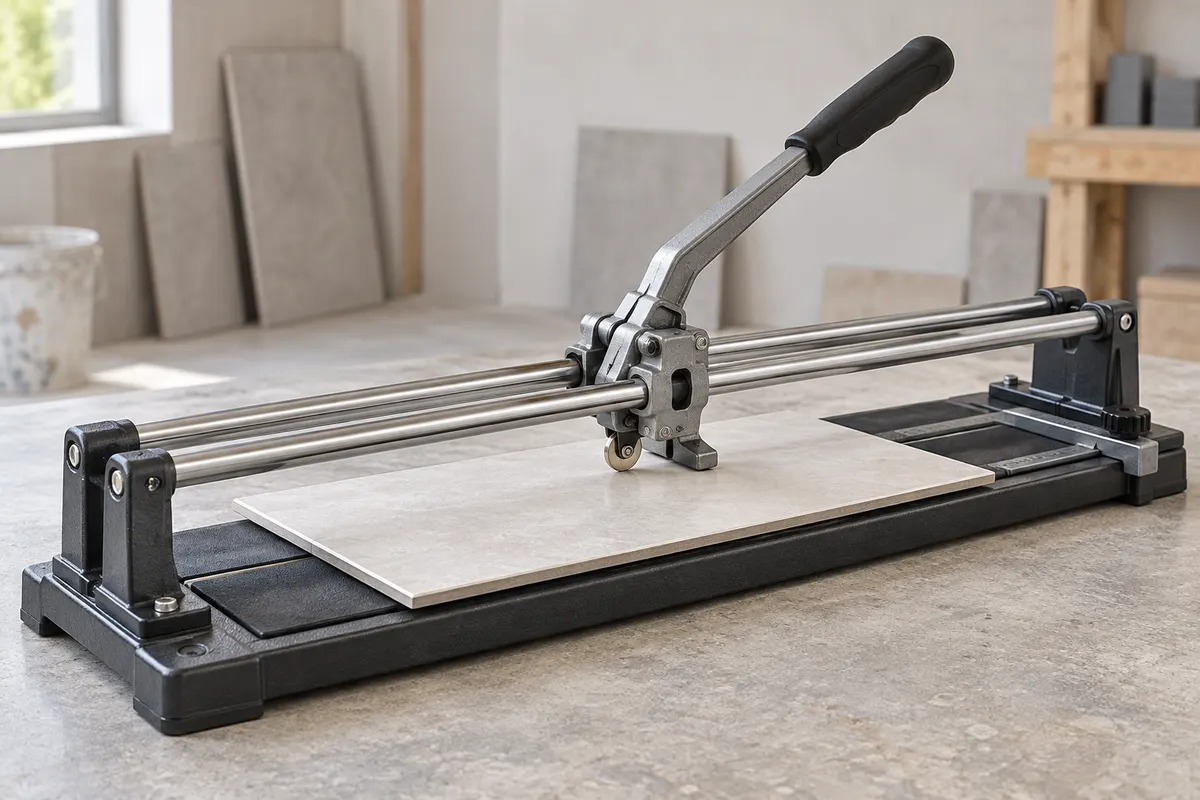
A REPEATABLE METHOD
How to use it
- Check cutter and scoring-wheel suitability for the actual tile material, thickness and required straight or diagonal span.
- Set the cutter on a stable surface, clean the bed and rails as the manual allows, and support large tiles without bending them.
- Measure and mark a spare tile. Check fence alignment against the mark; remember the visible face and waste side.
- Make the scoring pass and place the breaker exactly as the model manual specifies. Use controlled pressure, not repeated improvised scoring or body weight.
- Inspect a trial edge and its finished dimension. Smooth sharp edges by an approved method; keep a trial piece for comparison before cutting the visible batch.
INTERPRET THE MEASUREMENT
How to read the result
- A listed straight cutting length is not the diagonal tile side capacity.
- A good trial on one tile does not guarantee every texture, thickness or batch will separate cleanly.
- A narrow edge strip in the grid calculation may be outside the cutter’s practical capability; change the verified layout or use a suitable alternative method.
TROUBLESHOOT THE METHOD
Common problems and what to check
Break wanders off the score
Check wheel, tile suitability, bed cleanliness and model-specific breaker placement. Try a spare tile; do not increase force indefinitely.
Tile chips at the visible face
Inspect the wheel and technique. Reject a damaged exposed edge rather than hide it with an uncontrolled joint width.
Required cut is a notch or very narrow strip
Choose an appropriate cutting method with its own dust and safety controls; do not twist the tile against the rails.
STOP BEFORE THE HAZARD
Safety boundary
- Wear eye protection and handle sharp tile edges with suitable protection.
- Keep fingers away from the scoring wheel and breaker; support both sides of the tile.
- Manual cutting is not an excuse to grind tiles dry without appropriate dust controls. Follow the alternative tool’s safety procedure.
SMART BUYING GUIDE
What to look for when choosing
- Test the actual tile where possible, and check diagonal as well as straight capacity.
- Check wheel compatibility and availability, rail rigidity and large-tile support.
Types of tool
Best for: Compatible smaller tiles within verified thickness and cut limits.
Best for: Larger compatible tiles; rail length alone does not guarantee successful narrow cuts.
Common functions
Worth paying more for
- Stable fence, appropriate wheel and rigid supported bed.
- A model whose manual clearly states material and thickness limits.
Usually not worth the extra cost
- Breaking-force numbers treated as universal material compatibility.
- Claims that one manual cutter makes every hole and corner notch.
Sources & instructions
AI-generated topic illustration; do not use the depicted scale for measurements.
Put the measurements to work
Build a checkable room finish take-off from measured surfaces, declared product coverage and explicit rounding decisions.
Plan flooring and wallpaper without hiding wasteSeparate measured area, effective product coverage, layout allowance and whole-pack purchasing.