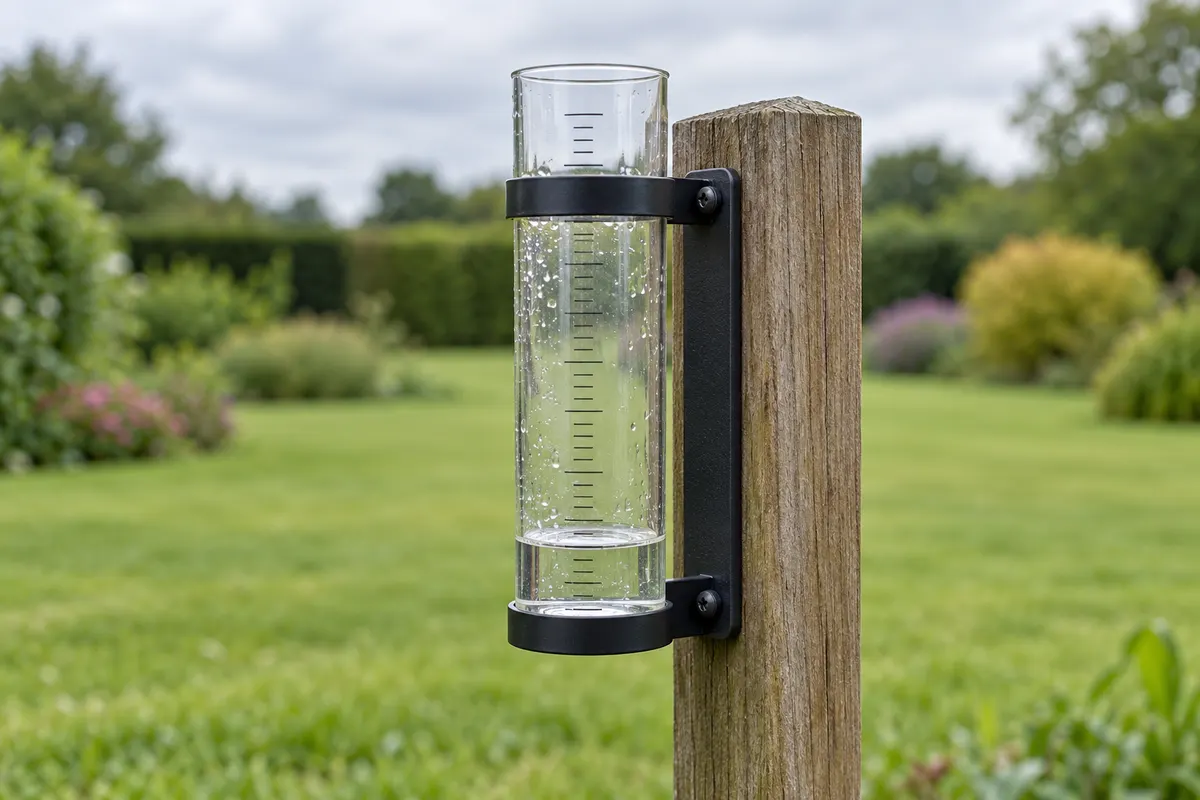
A REPEATABLE METHOD
How to use it
- Choose an open, safely accessible site without overhead cover, roof runoff or irrigation spray. Follow the gauge’s siting instructions.
- Fix the collector upright and keep the collecting rim level. Check stability, cleanliness and scale units.
- Read the calibrated scale at eye level using the prescribed method. Record time, amount and anything that could affect the observation.
- For a manual collecting gauge, empty it after recording and keep observation periods consistent; follow the model’s overflow procedure if capacity was exceeded.
- Compare a series of observations rather than extrapolating an annual supply from one wet week.
INTERPRET THE MEASUREMENT
How to read the result
- 1 mm of rainfall over 1 m² corresponds to 1 litre before collection losses. Roof yield still depends on horizontal catchment area and system losses.
- An event total of 12 mm does not tell you the peak intensity in mm/hour. Gutter and drain design needs suitable local design rainfall data.
- A funnel gauge’s collecting area and tube area may differ: use its calibrated scale, not an uncalibrated ruler inside the tube.
TROUBLESHOOT THE METHOD
Common problems and what to check
Problem
The result is much higher than nearby observations.
What to do
Check roof drips, splashes and irrigation; neighbouring measurements are a comparison, not an automatic correction.
Problem
A rainy period produces little or no collected water.
What to do
Check shelter, debris, a leaking collector or overflow. Record uncertainty rather than inventing missing rainfall.
Problem
The gauge is frozen or cracked.
What to do
Follow its cold-weather limits and inspect for damage. Ordinary unheated gauges may not measure snow or frozen precipitation reliably.
STOP BEFORE THE HAZARD
Safety boundary
- Install and read it from stable ground, without climbing onto a roof.
- Avoid buried services when setting a support and keep projecting posts out of walking routes.
- Collected rainwater and the gauge are not a drinking-water source; handle glass and damaged parts carefully.
SMART BUYING GUIDE
What to look for when choosing
- Look for a clear calibrated scale, secure mounting and useful capacity.
- Choose a manual collector for simple records; consider logging only if you need time-resolved observations.
Types of tool
Best for: A simple rainfall total over an explicitly recorded period.
Best for: Time-stamped observations, with power, communication and maintenance requirements.
Common functions
Rainfall-depth scaleRemovable collectorOptional mounting bracketManual observation log
Worth paying more for
- A readable scale and stable collecting geometry
- A mounting arrangement suited to an open location
Usually not worth the extra cost
- App features for an occasional manual reading
- A tiny graduation without documented accuracy or adequate siting
Sources & instructions
- AcuRite: manual rain gauge and units
- AcuRite: collector placement and level mounting
- AcuRite: debris and freezing limitations for an example collector
AI-generated topic illustration; do not use the depicted scale for measurements.