A REPEATABLE METHOD
How to use it
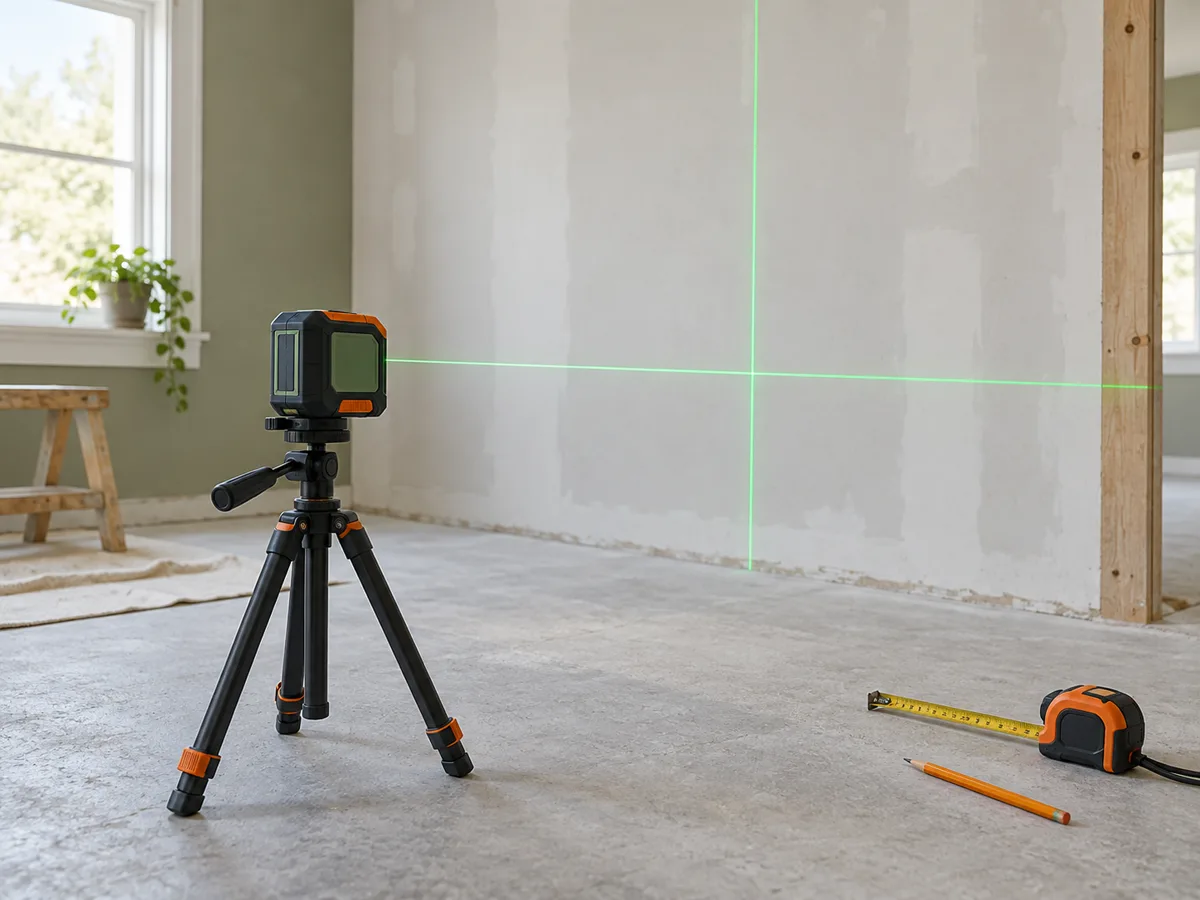
- Place the laser on a stable tripod or bracket and keep the beam below eye level where practical.
- Unlock self-leveling mode, wait for the line to settle and make sure no out-of-range warning is active.
- Measure from a known benchmark instead of assuming the floor, ceiling or first fixture is correct.
- Mark small reference ticks rather than tracing the full thick beam; use the center of the line consistently.
- Before critical work, compare marks after rotating the unit 180 degrees and repeat at the working distance.
INTERPRET THE MEASUREMENT
How to read the result
- Accuracy is normally stated as a deviation over distance; a small specification error grows across a long room.
- Green lines are often easier to see indoors, while a detector—not beam color—is what extends outdoor working range.
- Locked or slope mode intentionally disables self-leveling, so the line is not a level reference in that mode.
TROUBLESHOOT THE METHOD
Common problems and what to check
Problem
The line flashes or the unit beeps.
What to do
The base is probably outside the self-leveling range. Reposition or level the tripod rather than trusting the flashing line.
Problem
The line is too thick or dim at the far wall.
What to do
Reduce ambient light, move closer, use a target plate or compatible detector, and mark the same part of the line each time.
Problem
Marks disagree after the laser is moved.
What to do
Return to the same benchmark, check the mount for movement and perform a simple reversal calibration check before continuing.
STOP BEFORE THE HAZARD
Safety boundary
- Never stare into the beam or aim it at another person, reflective traffic or an aircraft.
- Keep the beam below eye level and follow the laser class and regional workplace rules.
- Use a secure tripod and safe access equipment; a laser does not replace structural survey or utility detection.
SMART BUYING GUIDE
What to look for when choosing
- Match the layout: a basic cross-line unit suits one wall, while 360-degree planes help align several walls and trades.
- Look for a pendulum lock, useful bracket adjustment, replaceable batteries and a stated accuracy at distance.
- Pay for detector compatibility when you genuinely need bright-room or outdoor range.
Types of tool
Best for: Shelves, cabinets, tile courses and one-wall layouts.
Best for: Whole-room partitions, ceilings and simultaneous trade layout.
Best for: Long-range outdoor grading and construction work.
Common functions
Self-leveling warningPendulum transport lockManual slope modePulse or detector modeFine-adjust mounting base
Worth paying more for
- Stable calibration and a stated accuracy
- A rigid fine-adjust bracket or tripod
- 360-degree planes when they remove repeated setups
Usually not worth the extra cost
- Maximum line count for simple one-wall work
- Green beams when a short indoor red line is already visible
- Outdoor range claims without a compatible detector