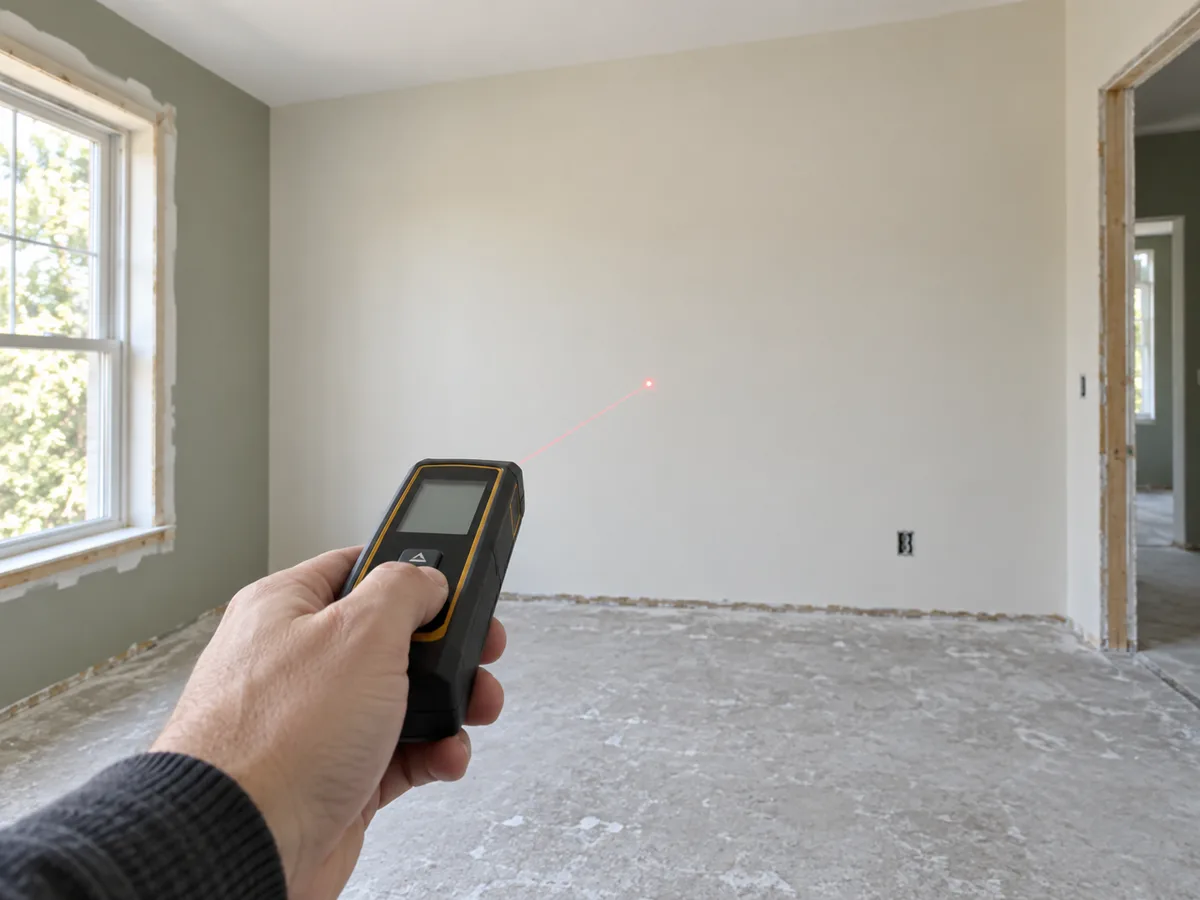
A REPEATABLE METHOD
How to use it
- Choose the front or rear reference edge and confirm the symbol before every series.
- Place the meter firmly against a stable surface and aim at a flat target, not an edge or opening.
- Keep the beam square to the target for width and height measurements.
- Take at least two readings and record the dimension with its location, not as an unlabeled number.
- Use a diagonal or independent tape check before ordering expensive material.
INTERPRET THE MEASUREMENT
How to read the result
- The displayed distance is from the selected reference edge to the laser target.
- Area and volume modes multiply measured dimensions; they do not correct a room that is out of square.
- Indirect height modes amplify angle and alignment errors and are planning estimates, not survey data.
TROUBLESHOOT THE METHOD
Common problems and what to check
Problem
Readings change when measuring the same wall.
What to do
Check the reference edge, steady the meter and aim at the same flat target point.
Problem
The laser is hard to see outdoors.
What to do
Shade the target or use a compatible target plate; a viewfinder helps at longer range.
Problem
A glossy or dark surface gives an error.
What to do
Use a matte target plate and avoid measuring through glass.
STOP BEFORE THE HAZARD
Safety boundary
- Never aim the laser toward eyes, people, traffic or reflective optical devices.
- Check for a safe footing before measuring heights or stairwells.
- Do not treat measurements as a structural survey or legal boundary determination.
SMART BUYING GUIDE
What to look for when choosing
- For interiors, 30–50 m range is usually enough; stability and readable controls matter more.
- A tilt sensor is useful for slopes and indirect checks, while a camera viewfinder helps outdoors.
- Verify stated accuracy over the distances you actually use and whether calibration can be checked.
Types of tool
Best for: Rooms, finishes and everyday renovation estimates.
Best for: Slopes, diagonals and approximate indirect heights.
Best for: Longer bright-light measurements where the dot is invisible.
Common functions
Front/rear referenceArea and volumeContinuous min/maxTilt sensorCamera viewfinder
Worth paying more for
- Consistent accuracy and a rigid reference edge
- Tilt sensing if you really measure slopes
- Optical viewfinder for frequent outdoor use
Usually not worth the extra cost
- A 200 m range for normal rooms
- Bluetooth if handwritten room notes are enough
- Indirect modes used as a substitute for careful direct measurement