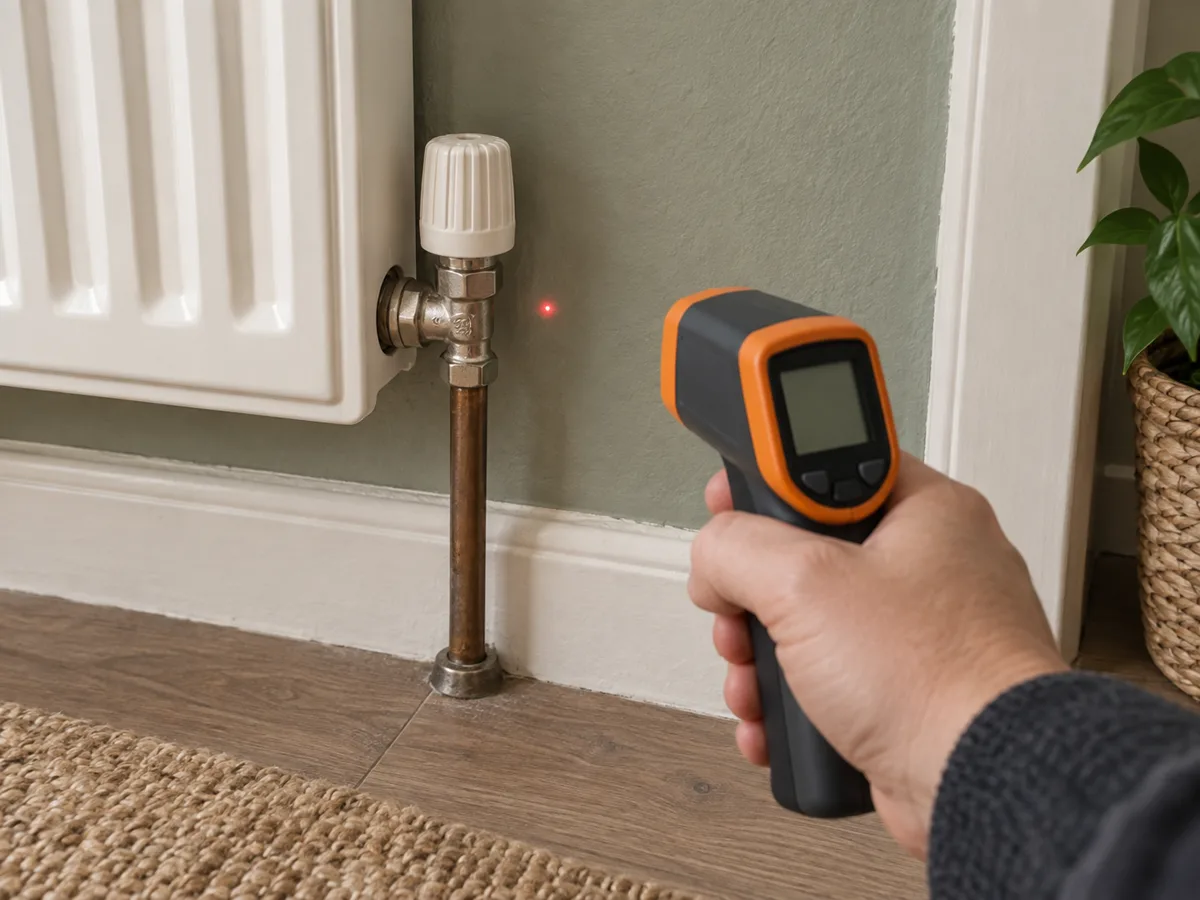
A REPEATABLE METHOD
How to use it
- Check the distance-to-spot ratio and move close enough that the target fills the measurement spot.
- Set emissivity when available, or place matte tape on a shiny surface and allow it to reach temperature.
- Aim squarely, hold the trigger until stable and record the surface and operating condition.
- Compare similar surfaces at the same distance rather than relying on one isolated reading.
- Confirm critical temperatures with a suitable contact probe or manufacturer test method.
INTERPRET THE MEASUREMENT
How to read the result
- The instrument reads a surface average, not air temperature and not the inside of a pipe.
- The red dot is not the measured spot size; at distance the sensor may include the background.
- Comparative readings are often more reliable than absolute values on unknown materials.
TROUBLESHOOT THE METHOD
Common problems and what to check
Problem
A copper pipe reads much colder than expected.
What to do
Bare metal has low emissivity and reflects the room. Measure matte tape attached to the pipe.
Problem
A small fitting changes temperature with distance.
What to do
The measurement spot is larger than the fitting. Move closer or use a higher optical ratio.
Problem
Wall readings vary under sunlight.
What to do
Wait for stable conditions and compare shaded surfaces after solar effects have reduced.
STOP BEFORE THE HAZARD
Safety boundary
- Do not use a remote reading as proof that a surface is safe to touch.
- Keep away from live parts, flames and moving equipment while aiming.
- Never look into or point the aiming laser at eyes.
SMART BUYING GUIDE
What to look for when choosing
- A useful optical ratio and adjustable emissivity matter more than an extreme temperature range.
- Choose a narrow enough spot for pipes and fittings at your normal working distance.
- For building envelopes, a thermal camera is more useful for finding patterns; the thermometer is better for spot comparisons.
Types of tool
Best for: Matte household surfaces and quick comparisons.
Best for: Mixed materials and more controlled troubleshooting.
Best for: Smaller targets from a safer working distance.
Common functions
Distance-to-spot ratioAdjustable emissivityMin/max scanHigh/low alarmContact-probe input
Worth paying more for
- A better optical ratio for small targets
- Adjustable emissivity and repeatable response
- Contact-probe input when absolute temperature matters
Usually not worth the extra cost
- Very high furnace temperatures for home use
- A second laser without improved optics
- Tiny claimed accuracy on reflective surfaces