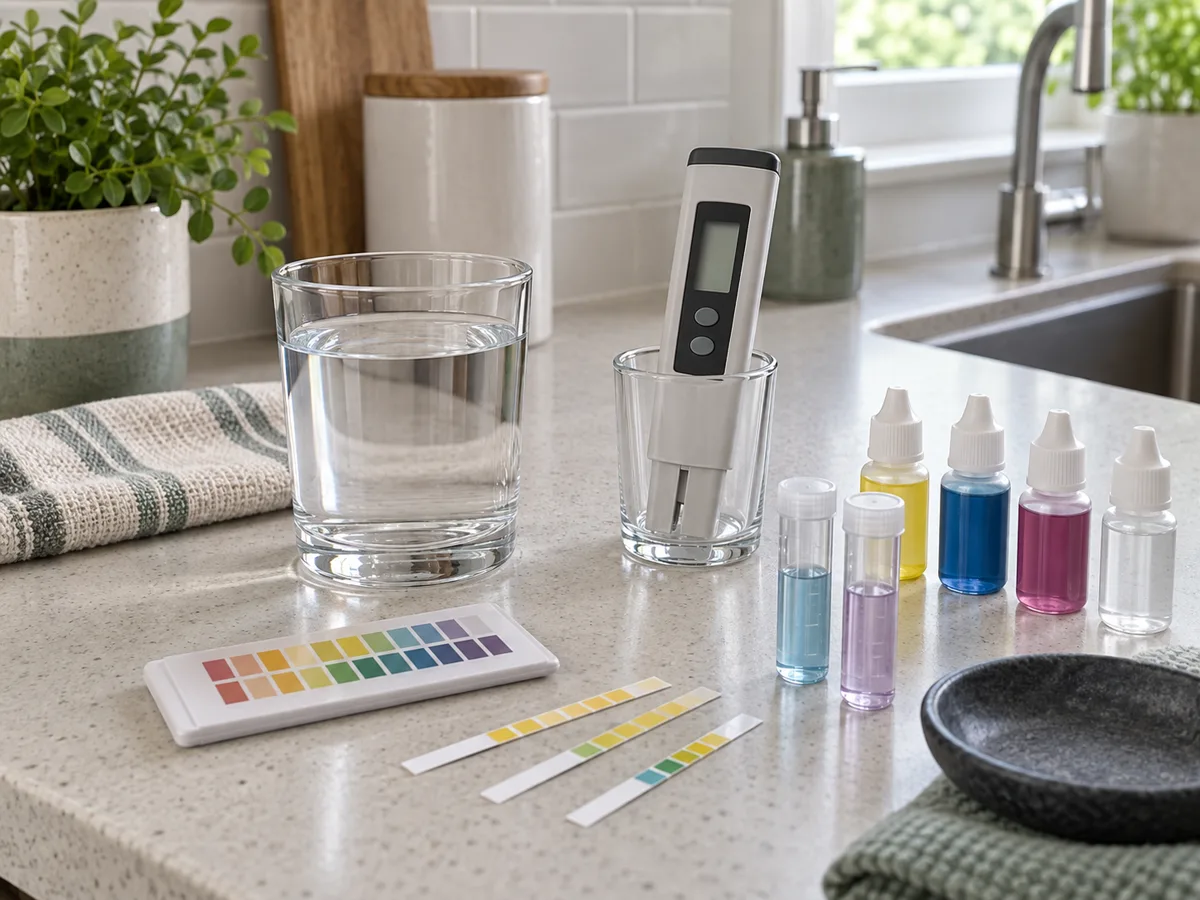
A REPEATABLE METHOD
How to use it
- Choose tests for a specific question and check the range, expiry date and storage condition.
- Flush or disinfect the sampling point as required by the method and use a clean container.
- Follow the stated sample volume, contact time, temperature and color-reading window exactly.
- Run a blank, duplicate or known reference when the decision matters, and write down units.
- Confirm unexpected or health-relevant results through an accredited laboratory before changing treatment.
INTERPRET THE MEASUREMENT
How to read the result
- TDS or conductivity indicates dissolved ions; a low number does not prove that water is safe.
- Hardness tests guide softener settings but do not measure iron, bacteria or organic contamination.
- Color strips are approximate and can be affected by lighting, timing, disinfectant and sample color.
TROUBLESHOOT THE METHOD
Common problems and what to check
Problem
The electronic meter changes every time.
What to do
Rinse the probe, remove bubbles, allow temperature compensation to settle and check calibration solution.
Problem
Strip colors sit between two chart values.
What to do
Read under neutral light at the exact specified time and report a range rather than false precision.
Problem
Water looks clear but smell or taste changed.
What to do
Stop relying on appearance and arrange targeted laboratory testing and a source inspection.
STOP BEFORE THE HAZARD
Safety boundary
- Do not drink water declared unsafe or under a boil advisory because a home strip looks normal.
- Handle reagents as labeled, keep them away from children and never mix test chemicals.
- Use a laboratory sampling kit for bacteria, metals and regulated drinking-water decisions.
SMART BUYING GUIDE
What to look for when choosing
- Buy tests matched to your source and treatment: hardness and iron for a softener are different questions from bacteria.
- Check detection range, expiry date, replacement reagents and calibration standards before buying.
- Prefer one reliable parameter-specific method over a large strip claiming many poorly resolved results.
Types of tool
Best for: Quick broad screening and deciding what to test properly.
Best for: Better hardness, alkalinity or disinfectant estimates.
Best for: Frequent trend checks with calibration and maintenance.
Best for: Health decisions, new wells and legal compliance.
Common functions
Detection rangeResolutionTemperature compensationTwo-point calibrationReplaceable reagents
Worth paying more for
- Parameter-specific tests with a useful range
- Fresh calibration standards and replaceable reagents
- Accredited laboratory analysis when health is involved
Usually not worth the extra cost
- A huge parameter count on one low-resolution strip
- Uncalibrated digital meters with extra decimal places
- Claims that TDS alone proves purity or safety