A REPEATABLE METHOD
How to use it
- Make the item stationary and safe; check that both surfaces and the reference tool are clean and supported.
- Confirm the leaf units and thickness markings. Remove leaves with rust, kinks or damaged edges from measurement use.
- Start with a thin leaf and slide it into the gap gently, keeping it aligned without lifting the reference or spreading the surfaces.
- Try successively thicker leaves at the same marked point; stop when insertion would require force.
- Record the thickest freely entering leaf and the next leaf that will not enter without force, plus the position and method. Repeat to check consistency.
INTERPRET THE MEASUREMENT
How to read the result
- Passing and non-passing leaves bracket the gap under the test conditions; they do not produce infinitely precise values.
- If the smallest leaf will not enter, the gap is below that test size, not necessarily zero. If the largest enters, the set has not found the upper bound.
- A leaf’s nominal thickness, its manufacturing tolerance, dirt and operator force are different sources of uncertainty.
TROUBLESHOOT THE METHOD
Common problems and what to check
The blade jams or scratches
Stop; check alignment and debris. Do not use the leaf as a wedge or scraper.
The gap changes while testing
Support the reference and eliminate rocking. A moving surface cannot give a repeatable clearance check.
The available sizes do not cover the gap
Choose the correct range or another specified gap gauge; do not invent an upper bound or casually stack leaves without an appropriate method.
STOP BEFORE THE HAZARD
Safety boundary
- Keep fingers clear of thin metal edges and close the leaves for transport.
- Do not insert conductive leaves into sockets, energized equipment or moving machinery.
- This guide is not an engine, gas-appliance or safety-device adjustment procedure; follow the equipment-specific service instructions and competence requirements.
SMART BUYING GUIDE
What to look for when choosing
- Match the range, increments, width and reach to the actual gap.
- Choose readable units and smooth undamaged leaves; keep them clean, dry and protected according to the maker’s care instructions.
Types of tool
Best for: Open accessible gaps with sufficient reach.
Best for: Restricted access where the stated leaf geometry suits the task.
Common functions
Worth paying more for
- Useful increments, readable thickness markings and a protective holder.
Usually not worth the extra cost
- Large leaf counts that omit the range or increments you actually need.
Sources & instructions
- Mitutoyo: thickness/feeler gauges and blade construction
- Mitutoyo: leaf ranges, units and thickness tolerances (E-36)
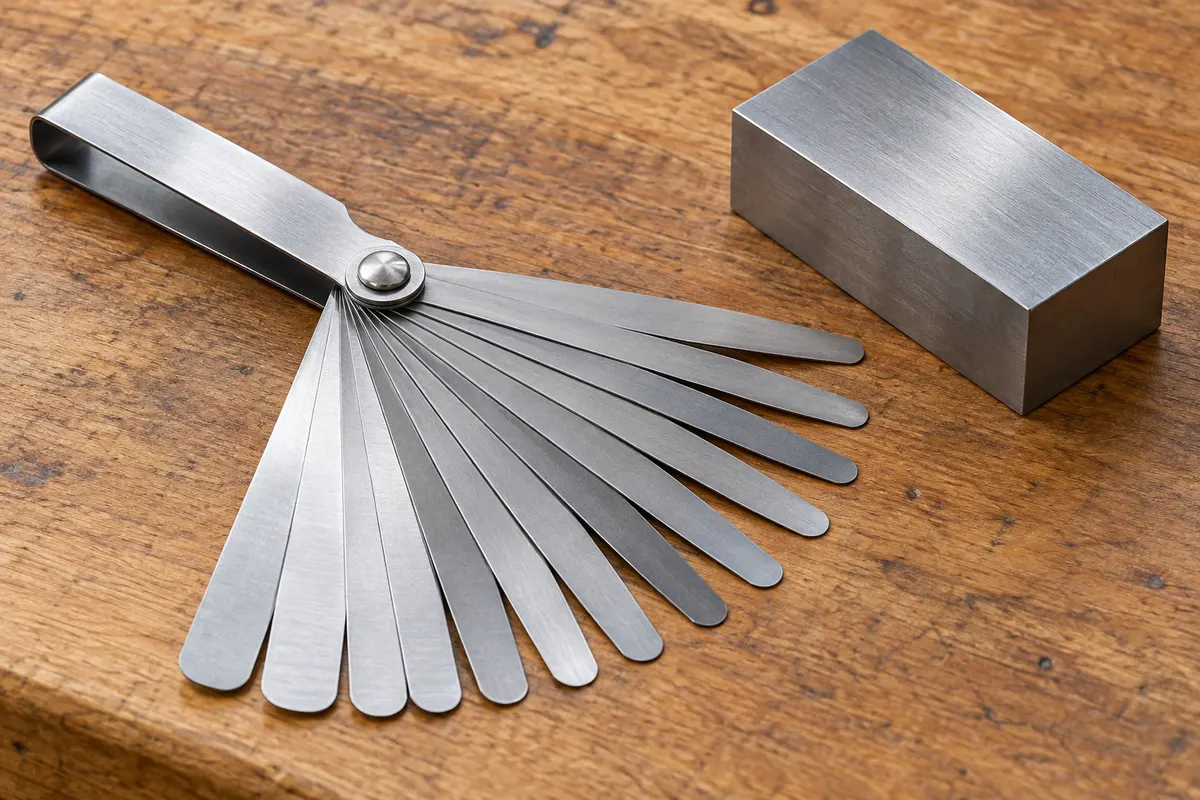
AI-generated topic illustration; do not use the depicted scale for measurements.
Put the measurements to work
Turn drawings and site measurements into transparent quantities without confusing an order estimate with structural or product design.
Plan flooring and wallpaper without hiding wasteSeparate measured area, effective product coverage, layout allowance and whole-pack purchasing.