A REPEATABLE METHOD
How to use it
- Check range, units, temperature-reference settings and the model’s EC-to-TDS factor. Use its approved calibration standard and procedure.
- Take a representative sample in a clean compatible vessel. Record source, sampling time and treatment stage.
- Rinse the sensor as instructed and immerse only to the permitted depth. Avoid trapped air; allow temperature and reading to settle.
- Record EC with units, temperature and compensation settings. If recording TDS, also note the conversion factor; compare like with like.
- Clean and store the electrode as its manual specifies. Follow unexpected changes with suitable laboratory tests, not a conclusion from EC alone.
INTERPRET THE MEASUREMENT
How to read the result
- 1000 µS/cm equals 1 mS/cm. A change of units is not a change in the sample.
- Illustratively, EC of 500 µS/cm multiplied by an assumed factor of 0.5 gives an estimated TDS of 250 mg/L. The factor is not universal and this is not a safety threshold.
- TDS, hardness and individual chemical concentrations are different quantities. Low EC or TDS cannot rule out microbes or every harmful contaminant.
TROUBLESHOOT THE METHOD
Common problems and what to check
Two testers disagree on the same sample.
Compare EC units, temperature compensation, conversion factors, calibration and stated accuracy before comparing the displayed TDS.
The value drifts after immersion.
Allow stabilization and check cleanliness, bubbles and the sample temperature. Repeat using the prescribed probe clearance.
An ordinary softener does not greatly reduce the reading.
Ion exchange is not the same as removing all dissolved material. Verify hardness with the appropriate test instead of rejecting or approving treatment from TDS.
STOP BEFORE THE HAZARD
Safety boundary
- Never approve water for drinking from this number alone; consult a suitable accredited laboratory and local health guidance.
- Do not taste an unknown sample or return a tested sample to the supply. Follow calibration-fluid handling and disposal instructions.
- Keep the meter away from live electrical parts, hot pressurized pipework and samples outside its stated compatibility.
SMART BUYING GUIDE
What to look for when choosing
- Choose a suitable EC range and documented accuracy, with available calibration standards.
- Prefer clearly identified units and conversion settings; display resolution alone is not measurement accuracy.
Types of tool
Best for: A conductivity log without an opaque TDS conversion.
Best for: Recording conductivity and an explicitly identified TDS estimate.
Common functions
Worth paying more for
- Documented accuracy and maintainable electrodes
- Visible units and known compensation/conversion settings
Usually not worth the extra cost
- A generic drinking-water safety score
- An unexplained ppm display without calibration information
Sources & instructions
- Hanna Instruments: example EC/TDS tester and conversion settings
- Hanna Instruments: calibration, temperature and misleading readings
- Hanna Instruments: example EC/TDS tester manual
- US EPA: laboratory testing of private-well water
- USGS: water hardness and ion-exchange softening
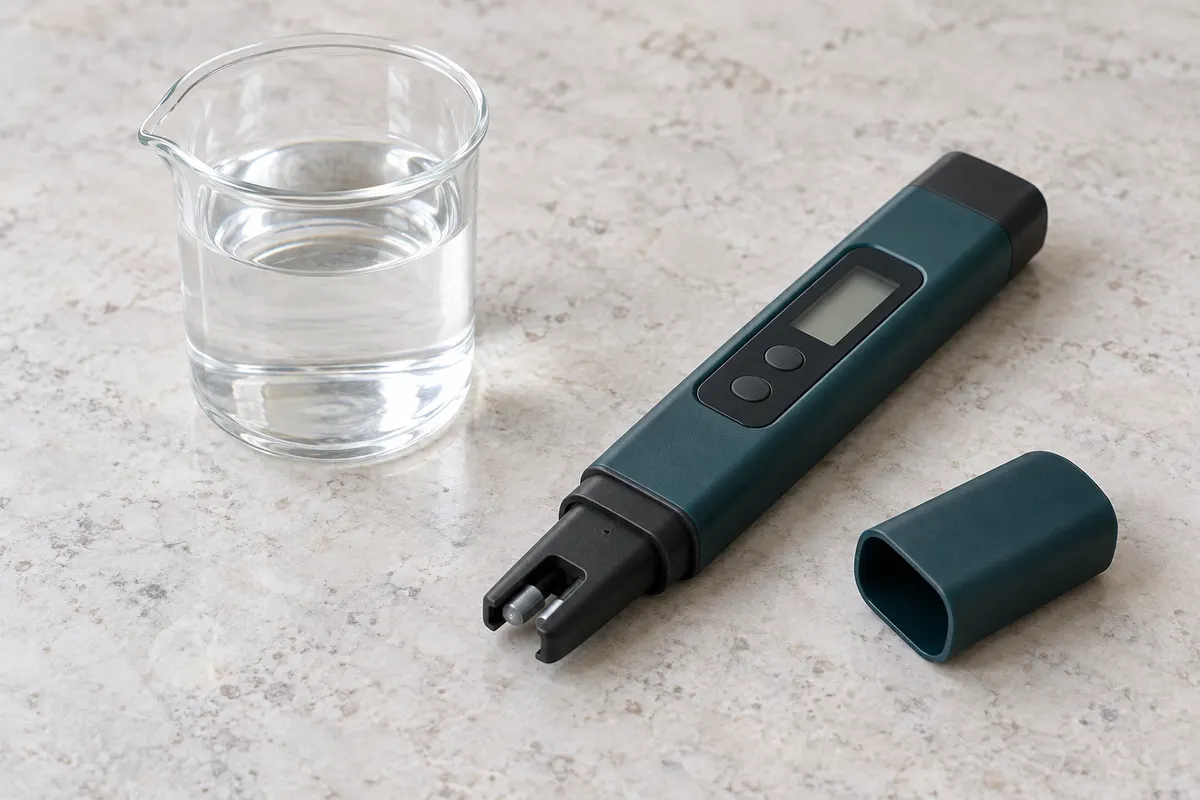
AI-generated topic illustration; do not use the depicted scale for measurements.
Put the measurements to work
Choose stages from measured contaminants, treatment goals and required flow.
Read a private-well water test before choosing treatmentCheck the sample, units, detection limits and health context before comparing equipment.
Maintain a home water-treatment train as one systemTrack flow, pressure, capacity, sanitation and verification across every treatment stage.