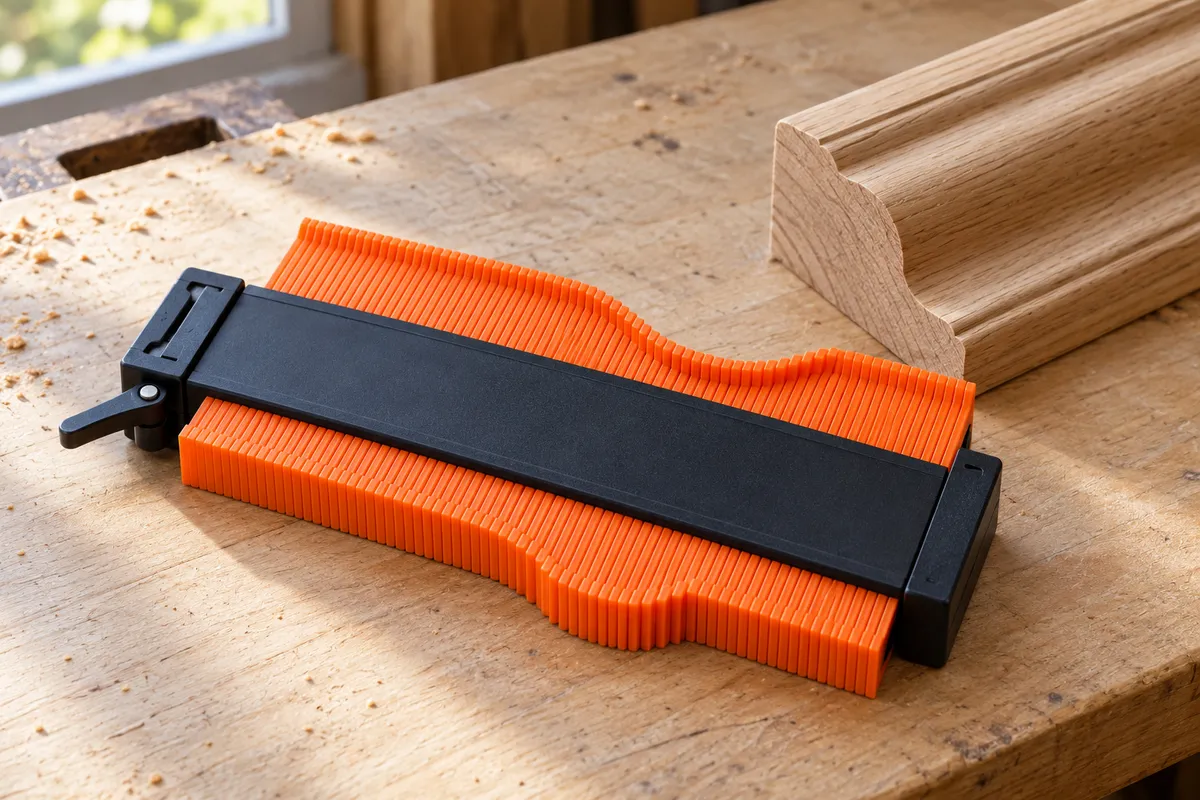
A REPEATABLE METHOD
How to use it
- Mark the reference face, orientation and position on the workpiece.
- Unlock and reset the pins; press gently against the accessible profile without tilting.
- Lock the pins when supported and lift the gauge without changing the outline.
- Transfer the profile using the same reference face and check that it is not mirrored.
- Add the material supplier’s clearances and cutting allowance; test a disposable template before the final cut.
INTERPRET THE MEASUREMENT
How to read the result
- Pin width limits how well narrow details can be captured.
- The copied shape belongs to one position and plane, not the entire three-dimensional object.
- Expansion gaps, sealant space and saw-cut width must be planned separately.
TROUBLESHOOT THE METHOD
Common problems and what to check
Problem
The outline changes during transfer
What to do
Check the lock and pin friction; support the housing and repeat on a template.
Problem
The part fits the wrong way around
What to do
Recheck the marked face, location and orientation before recutting.
STOP BEFORE THE HAZARD
Safety boundary
- Do not push the gauge against hot pipes, moving parts or exposed electrical equipment.
- Protect delicate finishes; avoid force and check the contact material first.
- A template does not make cutting safe: use the cutting tool’s guards, work support and required protection.
SMART BUYING GUIDE
What to look for when choosing
- Choose enough working width and pin travel for the profile.
- Check that the lock holds and the pins slide evenly without scratching the surface.
Types of tool
Best for: Finish work where a retained profile and gentle contact matter.
Best for: Smaller details on surfaces that tolerate its contact material.
Common functions
Local shape copying for templates, trim and floor-edge fitting.
Worth paying more for
- A dependable lock, smooth pins and the right usable depth.
Usually not worth the extra cost
- Oversized gauges that cannot reach the profile you need.
Sources & instructions
- Wolfcraft: contour gauge, locking pins and profile transfer
- Wolfcraft: laminate guide and contour-gauge workflow
AI-generated topic illustration; do not use the depicted scale for measurements.
Put the measurements to work
Measure paint and tile quantities before buying
Build a checkable room finish take-off from measured surfaces, declared product coverage and explicit rounding decisions.
Plan flooring and wallpaper without hiding wasteSeparate measured area, effective product coverage, layout allowance and whole-pack purchasing.