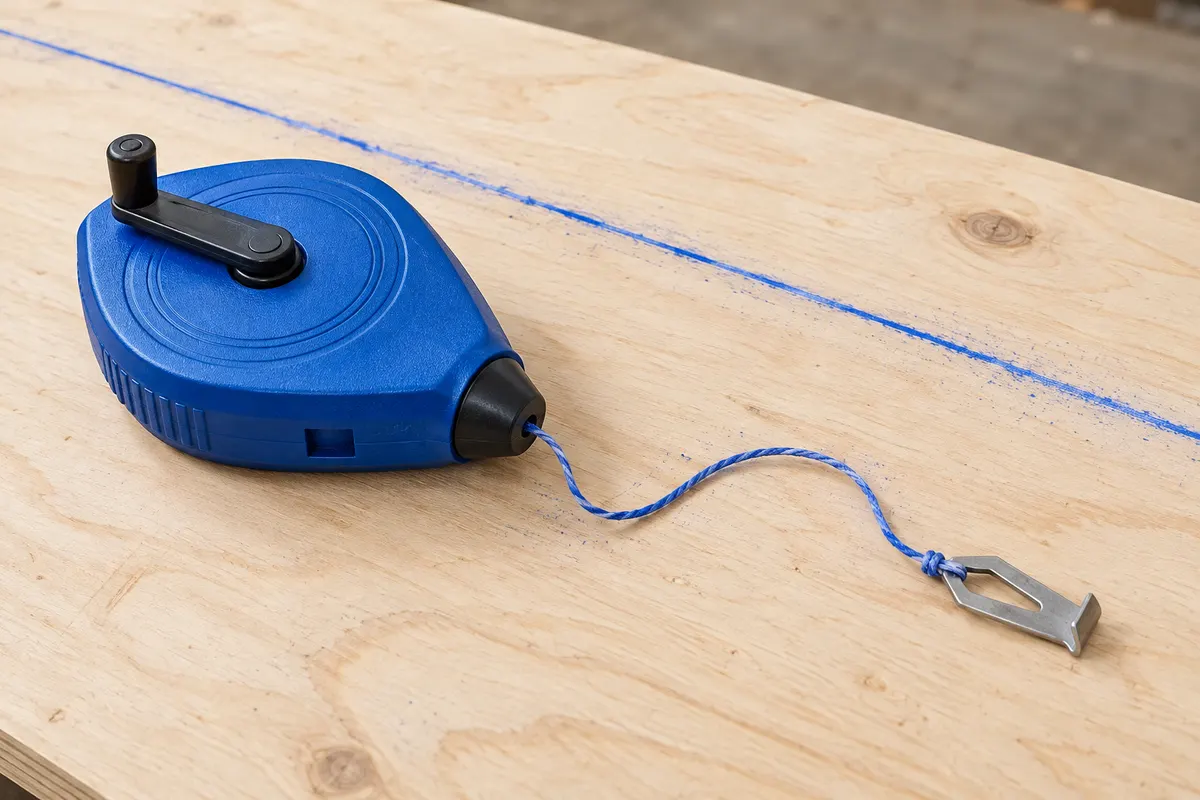
A REPEATABLE METHOD
How to use it
- Choose the reference: a tile grid centre, a board edge or another measured datum. Check both endpoints independently.
- Test the chalk on an offcut. Colour and formulation can leave permanent stains; never assume it washes from a visible finish.
- Fill and close the reel as its instructions require. Pull out coated line without spilling powder.
- Secure the hook, align the other end and tension the line without moving either reference. Keep it clear of obstacles.
- Lift a short part perpendicular to the surface and release once. Check the resulting mark against the endpoints; use one agreed edge or centre consistently.
INTERPRET THE MEASUREMENT
How to read the result
- The mark has width: a thick fuzzy stripe cannot support a sub-millimetre claim.
- A line spanning a hump or sagging gap does not represent a straight mark on that surface. Divide the task into verified spans.
- For a rectangular set-out, check measured sides and diagonals separately. Two lines that look perpendicular are not a verified square corner.
TROUBLESHOOT THE METHOD
Common problems and what to check
Problem
Double or fuzzy mark
What to do
Clean excess powder, reduce movement and make one controlled snap. Remove ambiguous marks without damaging the finish before retrying.
Problem
Hook moves
What to do
Use a secure non-damaging anchor or a helper. Recheck both endpoints, not just the middle.
Problem
Mark stains the final surface
What to do
Stop and use a tested removable marking method. Do not cover a stain with an incompatible coating.
STOP BEFORE THE HAZARD
Safety boundary
- Do not snap towards faces; keep bystanders clear of the tensioned line.
- Follow the chalk safety data and avoid inhaling powder; do not blow dust into the room.
- Mark from a stable position. Do not stretch across an unsupported opening or use the reel as fall protection.
SMART BUYING GUIDE
What to look for when choosing
- Choose line length for the actual span and chalk that suits the surface.
- A secure hook and controlled rewind matter more than a very fast winding ratio.
Types of tool
Best for: Finer set-out on smooth surfaces, with checked visibility.
Best for: Visible rough-work marks, not fine joinery accuracy.
Common functions
Long straight reference marking.Repeatable grid lines from independently measured endpoints.
Worth paying more for
- Reliable hook, line and refill closure.
- Replacement line and a reel that winds without tangles.
Usually not worth the extra cost
- Claims that a chalk line checks level or square.
- Permanent chalk for a job needing removable marks.
Sources & instructions
AI-generated topic illustration; do not use the depicted scale for measurements.