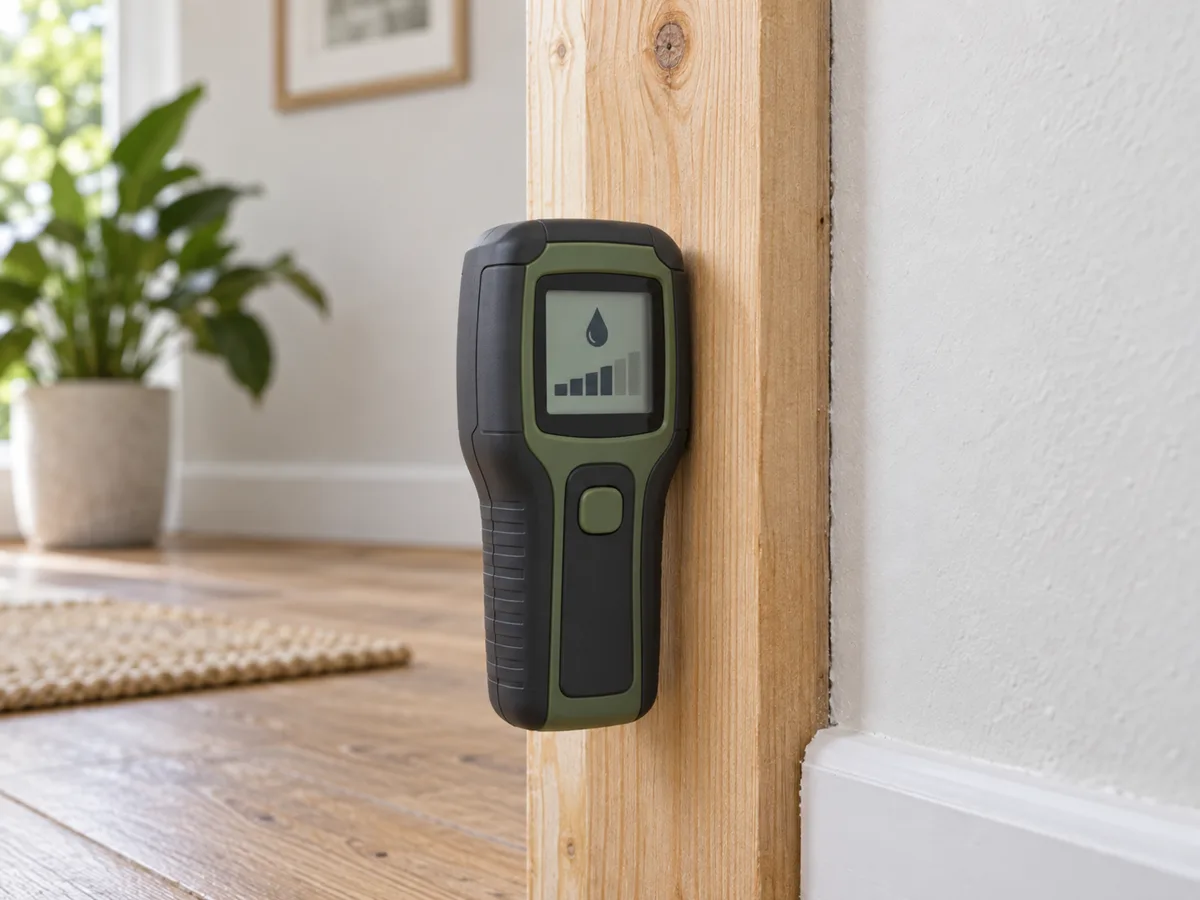
EINE WIEDERHOLBARE METHODE
So wird es benutzt
- Identify the material and choose the matching mode or correction setting when the meter provides one.
- Measure a known dry area of the same material to create a local baseline.
- Take a grid of readings across and beyond the suspect area rather than testing one point.
- Repeat at different depths or from the opposite side when accessible, and note recent weather or plumbing use.
- Investigate the moisture source and confirm important decisions with an appropriate reference method.
MESSWERT VERSTEHEN
Ergebnis verstehen
- Timber percentage modes may estimate moisture content; drywall or masonry scales are often relative indexes.
- Pinless depth is approximate and readings can be raised by pipes, screws, foil or dense material.
- Trend and boundary shape are often more useful than an isolated absolute number.
METHODE PRÜFEN
Häufige Probleme und Prüfungen
Problem
The meter reports a wet vertical line in an otherwise dry wall.
Was tun
Check for a metal stud, pipe or cable before concluding that the line is moisture.
Problem
Pin readings vary widely a few millimetres apart.
Was tun
Grain, salts, surface contamination and uneven contact can affect resistance. Repeat and compare a wider pattern.
Problem
The surface looks dry but the reading remains elevated.
Was tun
Moisture may remain below the surface, or another material may be influencing the sensor. Confirm with a second method.
VOR DER GEFAHR STOPPEN
Sicherheitsgrenze
- Locate concealed wiring and pipes before pushing pins into a wall or floor.
- Wear suitable protection around contaminated water, damaged materials or suspected mold.
- Do not declare a building safe, dry or mold-free from one meter reading.
RATGEBER FÜR DEN SINNVOLLEN KAUF
Worauf beim Kauf achten
- Choose pin mode for depth comparisons and pinless mode for rapid non-destructive mapping; combination meters can do both.
- Useful features include material selection, hold, a reference scale and replaceable insulated pins.
- Check the stated sensing depth and calibration purpose rather than relying on an unexplained green-yellow-red light.
Gerätearten
Am besten für: Timber moisture estimates and depth comparison with insulated pins.
Am besten für: Rapid non-destructive mapping over walls and floors.
Am besten für: Finding a suspect area, then checking it more closely.
Typische Funktionen
Material or timber-species correctionRelative reference modeSelectable sensing depthHold and alarm thresholdReplaceable insulated pins
Dafür lohnt sich der Aufpreis
- Repeatable readings and stated calibration purpose
- Both pin and pinless modes if you inspect mixed materials
- Replaceable probes and a useful depth specification
Dafür lohnt sich der Aufpreis meist nicht
- A vague green-yellow-red display with no scale
- Large species databases for occasional building checks
- Cloud reports before you have a sound measuring method