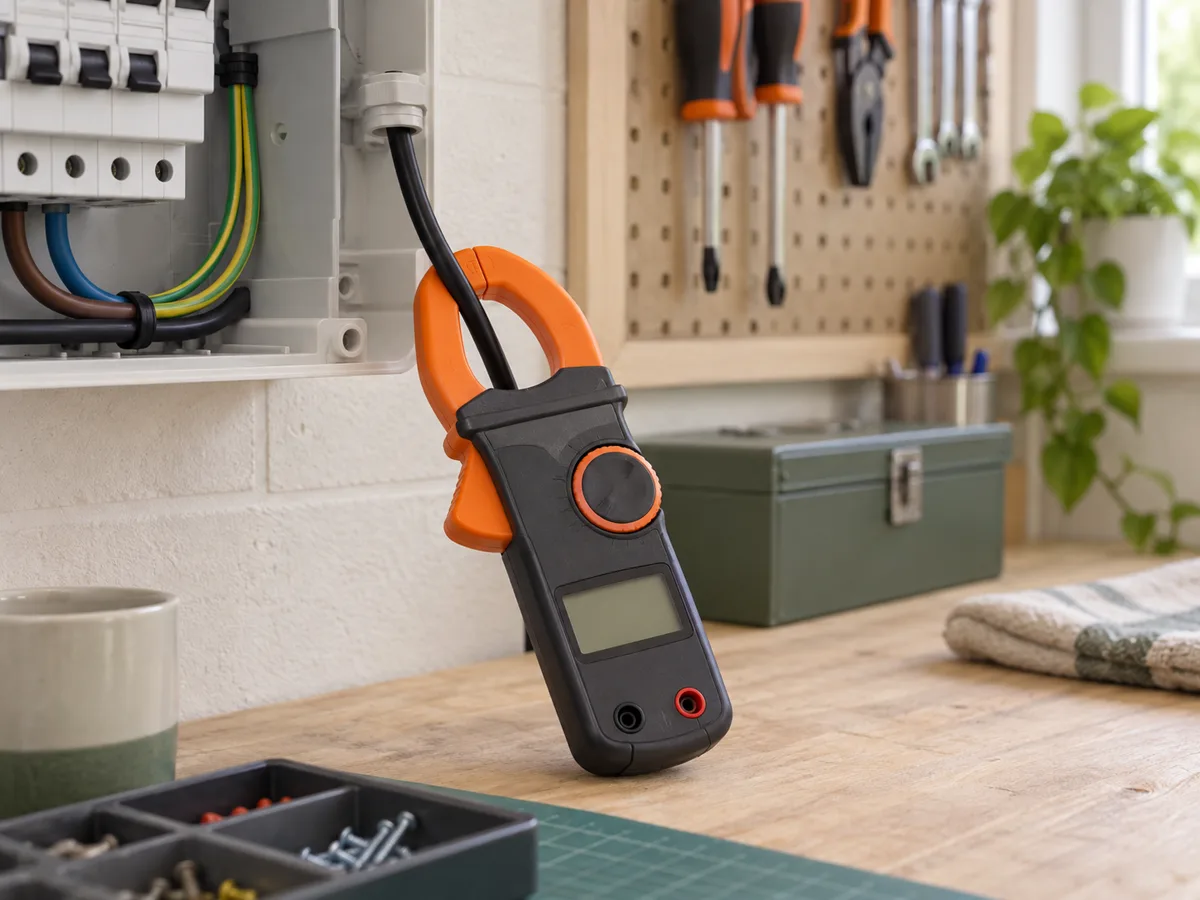
EINE WIEDERHOLBARE METHODE
So wird es benutzt
- Inspect the jaw, case and rating, then select AC or DC current as required.
- Zero a DC-capable clamp away from conductors before measuring.
- Place the jaw around one insulated conductor only and close it completely.
- Center the conductor in the jaw, keep other current-carrying wires away and wait for a stable value.
- Repeat under a known operating condition and compare running, minimum and starting current where relevant.
MESSWERT VERSTEHEN
Ergebnis verstehen
- Running current helps estimate load but does not by itself show power factor or real energy use.
- Starting current may last only fractions of a second, so peak or inrush capture can matter for motors.
- A near-zero reading around an entire cable is expected because outgoing and return currents cancel.
METHODE PRÜFEN
Häufige Probleme und Prüfungen
Problem
The display shows almost zero on a working appliance.
Was tun
Check that the jaw surrounds only one conductor, not the complete cord.
Problem
The DC reading drifts before the test.
Was tun
Close and zero the jaw away from conductors, then repeat at the same orientation.
Problem
The meter misses a pump or compressor start.
Was tun
Use a model with specified inrush capture and confirm that its response time suits the event.
VOR DER GEFAHR STOPPEN
Sicherheitsgrenze
- Do not open a panel or separate conductors unless you are qualified and the work method is safe.
- Use a meter with an independently verified category and voltage rating for the location.
- Keep fingers behind the guard and never clamp damaged insulation or exposed metal.
RATGEBER FÜR DEN SINNVOLLEN KAUF
Worauf beim Kauf achten
- Jaw opening must fit the conductor while still allowing it to sit near the center.
- Choose AC-only for ordinary mains loads; choose AC/DC for batteries, solar and inverter systems.
- Resolution at low current can matter more than an extremely high maximum range.
Gerätearten
Am besten für: Household circuits, motors and appliances on mains power.
Am besten für: Solar, batteries, vehicles and inverter systems.
Am besten für: Qualified investigation of very small imbalance currents.
Typische Funktionen
AC or AC/DC currentTrue RMSInrush captureLow-current resolutionMultimeter probe inputs
Dafür lohnt sich der Aufpreis
- Verified CAT rating and safe construction
- Reliable inrush capture for motors
- Good low-current resolution for standby loads
Dafür lohnt sich der Aufpreis meist nicht
- A 1000 A range for ordinary home circuits
- DC capability if you will only test AC loads
- Wireless logging for occasional spot checks