UM MÉTODO REPETÍVEL
Como usar
- Confirm that the gauge range and adapter suit the expected pressure and connection.
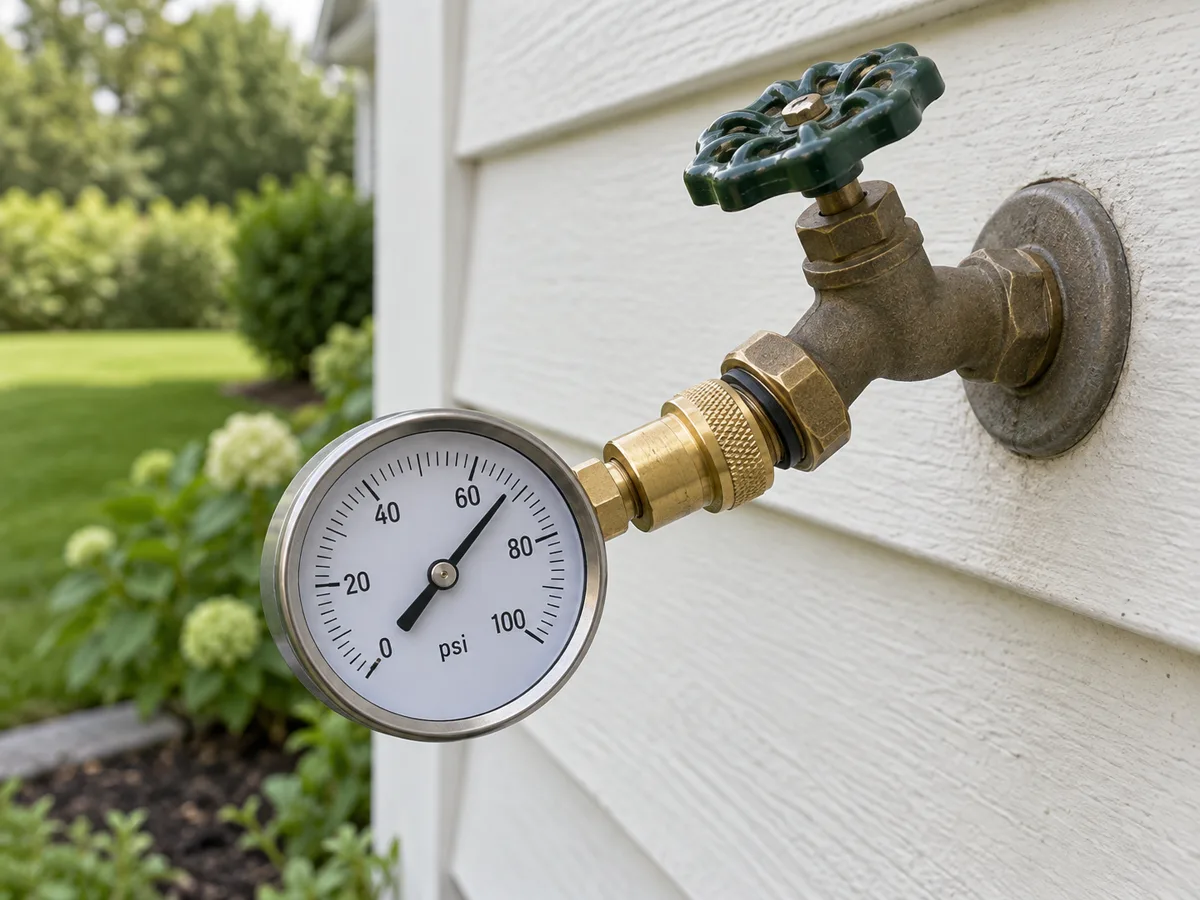
- Inspect the washer, attach the gauge squarely by hand and open the valve slowly while watching for leaks.
- Close other fixtures and record stable static pressure.
- Run a repeatable nearby demand and record dynamic pressure plus the approximate flow.
- Repeat at useful times and locations, then compare with equipment requirements and local limits.
INTERPRETAR A MEDIÇÃO
Como interpretar o resultado
- Static pressure shows the no-flow condition; it does not prove that the system can deliver enough water.
- A large pressure drop during flow points to limited source capacity, a restriction, a regulator or small piping.
- Pressure that cycles between two values may reflect pressure-switch operation on a pumped system.
VERIFICAR O MÉTODO
Problemas comuns e verificações
Problema
The needle falls slowly with every outlet closed.
O que fazer
First rule out gauge, washer and test-point leaks; then investigate hidden demand, a leaking valve or system backflow.
Problema
Pressure is normal but shower flow is poor.
O que fazer
Check the aerator, cartridge, filter, valve opening and pipe restriction. Pressure and available flow are different measurements.
Problema
The needle pulses rapidly on a pumped system.
O que fazer
Observe pump cycling and check the pressure tank and control arrangement rather than averaging an unstable reading.
PARAR ANTES DO PERIGO
Limite de segurança
- Use fittings rated for the system and never leave a temporary gauge unattended or exposed to freezing.
- Open and close valves slowly to limit water hammer and protect the gauge.
- Relieve pressure before removing the gauge and control the discharge so it cannot cause injury or water damage.
GUIA DE COMPRA INTELIGENTE
O que procurar ao escolher
- Choose a range that places normal pressure near the middle of the dial, with compatible units such as bar and psi.
- A drag pointer helps capture peak pressure; a glycerin-filled gauge steadies pulsation.
- A robust hose washer, brass adapter and readable scale are more useful than unnecessary precision.
Tipos de instrumento
Ideal para: Occasional static and flowing pressure checks.
Ideal para: Pulsating pump systems and capturing pressure peaks.
Ideal para: Long observations and intermittent pressure complaints.
Funções comuns
Useful pressure rangePeak drag pointerLiquid-filled movementDigital min/max loggingSuitable hose and test adapters
Pelo que vale a pena pagar mais
- A range that puts normal pressure near mid-scale
- Reliable fittings, washer and pressure rating
- Peak capture when diagnosing regulators or water hammer
Pelo que normalmente não vale pagar mais
- Laboratory accuracy for basic household screening
- A very high range that makes normal values hard to read
- Wireless logging for a one-time static check