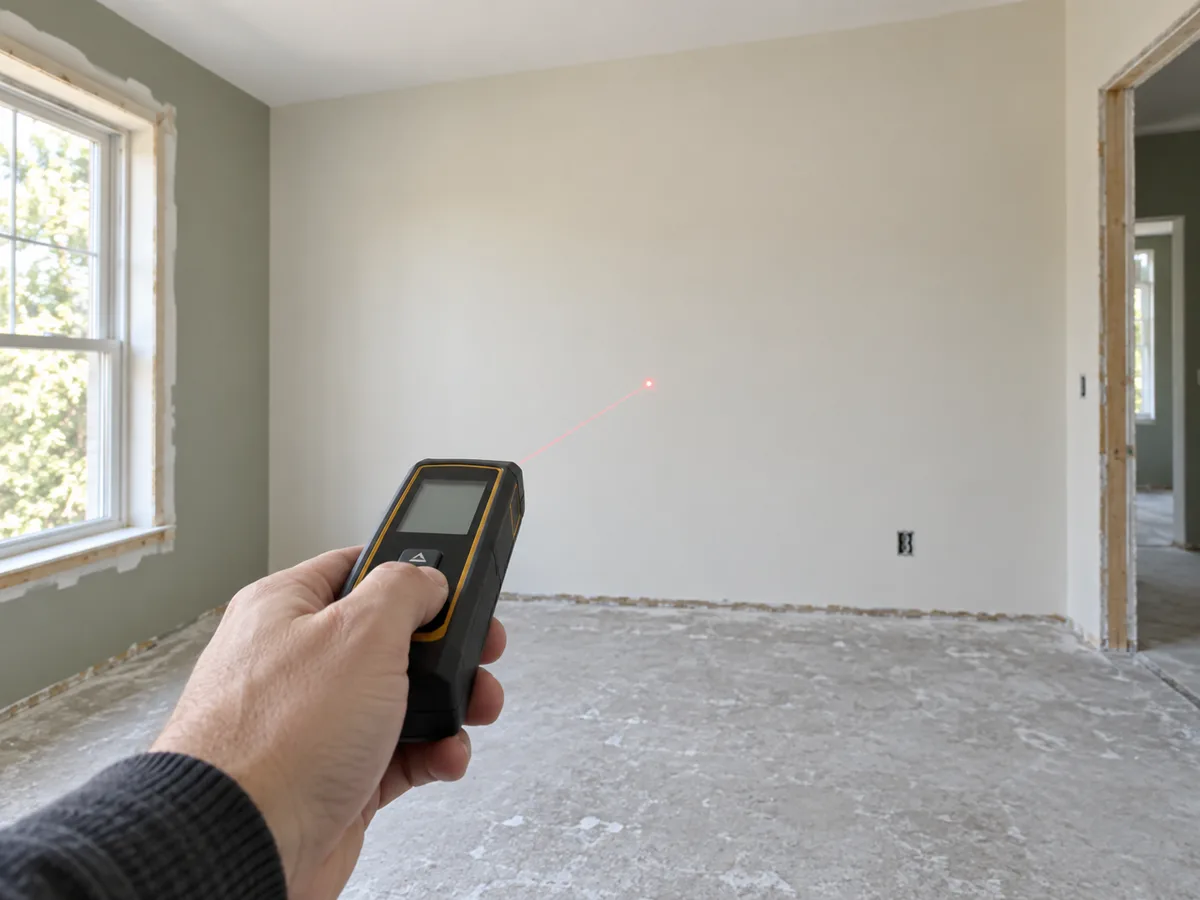
UM MÉTODO REPETÍVEL
Como usar
- Choose the front or rear reference edge and confirm the symbol before every series.
- Place the meter firmly against a stable surface and aim at a flat target, not an edge or opening.
- Keep the beam square to the target for width and height measurements.
- Take at least two readings and record the dimension with its location, not as an unlabeled number.
- Use a diagonal or independent tape check before ordering expensive material.
INTERPRETAR A MEDIÇÃO
Como interpretar o resultado
- The displayed distance is from the selected reference edge to the laser target.
- Area and volume modes multiply measured dimensions; they do not correct a room that is out of square.
- Indirect height modes amplify angle and alignment errors and are planning estimates, not survey data.
VERIFICAR O MÉTODO
Problemas comuns e verificações
Problema
Readings change when measuring the same wall.
O que fazer
Check the reference edge, steady the meter and aim at the same flat target point.
Problema
The laser is hard to see outdoors.
O que fazer
Shade the target or use a compatible target plate; a viewfinder helps at longer range.
Problema
A glossy or dark surface gives an error.
O que fazer
Use a matte target plate and avoid measuring through glass.
PARAR ANTES DO PERIGO
Limite de segurança
- Never aim the laser toward eyes, people, traffic or reflective optical devices.
- Check for a safe footing before measuring heights or stairwells.
- Do not treat measurements as a structural survey or legal boundary determination.
GUIA DE COMPRA INTELIGENTE
O que procurar ao escolher
- For interiors, 30–50 m range is usually enough; stability and readable controls matter more.
- A tilt sensor is useful for slopes and indirect checks, while a camera viewfinder helps outdoors.
- Verify stated accuracy over the distances you actually use and whether calibration can be checked.
Tipos de instrumento
Ideal para: Rooms, finishes and everyday renovation estimates.
Ideal para: Slopes, diagonals and approximate indirect heights.
Ideal para: Longer bright-light measurements where the dot is invisible.
Funções comuns
Front/rear referenceArea and volumeContinuous min/maxTilt sensorCamera viewfinder
Pelo que vale a pena pagar mais
- Consistent accuracy and a rigid reference edge
- Tilt sensing if you really measure slopes
- Optical viewfinder for frequent outdoor use
Pelo que normalmente não vale pagar mais
- A 200 m range for normal rooms
- Bluetooth if handwritten room notes are enough
- Indirect modes used as a substitute for careful direct measurement