UM MÉTODO REPETÍVEL
Como usar
- Inspect the case, lead insulation and probe tips. Do not use damaged equipment.
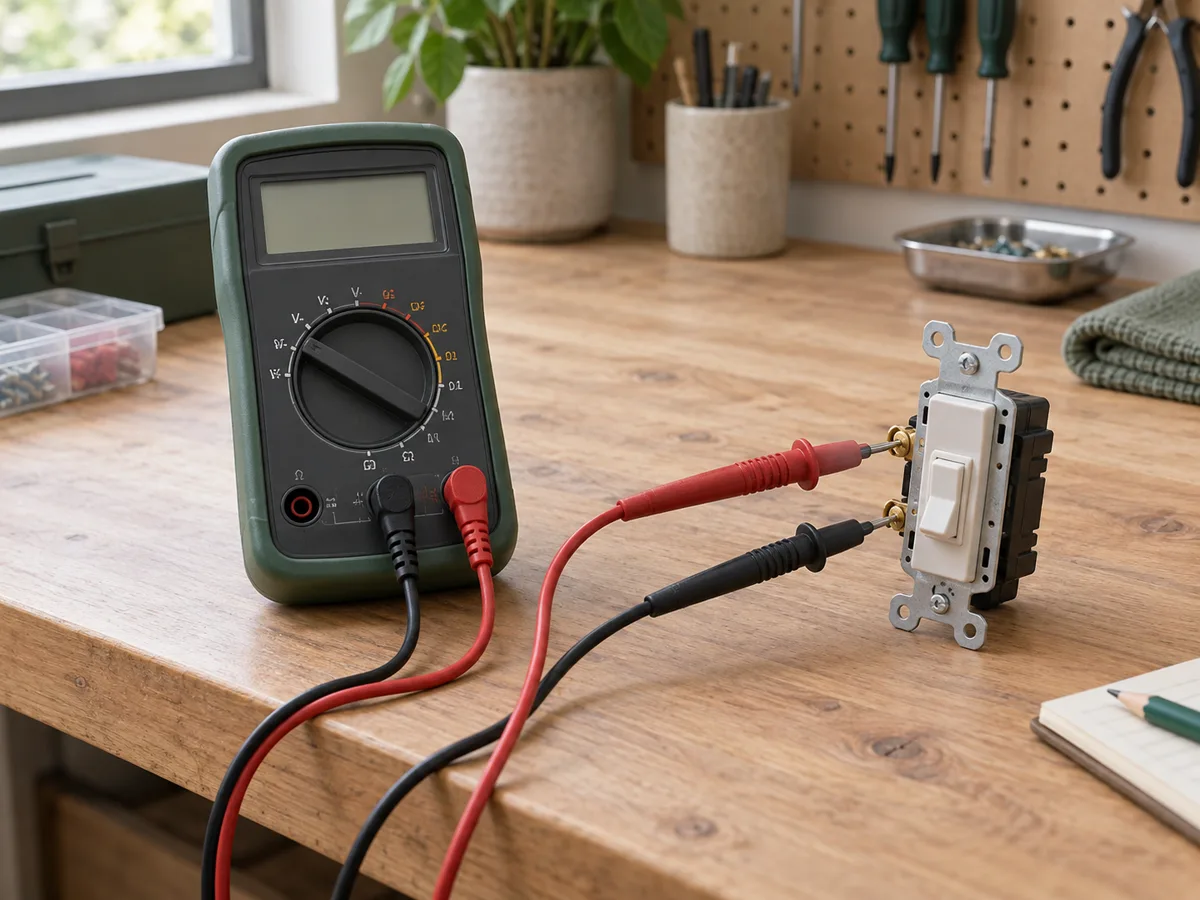
- Choose the measurement first, then place the leads in the correct sockets. The black lead normally stays in COM.
- For resistance or continuity, isolate the circuit and prove it is de-energized before touching the probes to it.
- Start with a range above the expected value when the meter is not auto-ranging, then reduce the range for a steadier display.
- Record the setting, units and test points with the result so the reading can be checked later.
INTERPRETAR A MEDIÇÃO
Como interpretar o resultado
- Voltage is the potential difference between two points. AC and DC modes are not interchangeable.
- Resistance is meaningful only on an isolated component; parallel paths can make an installed reading look lower.
- A continuity beep is a quick low-resistance screen, not proof that a cable can safely carry its design current.
VERIFICAR O MÉTODO
Problemas comuns e verificações
Problema
The display stays at overload or does not change.
O que fazer
Check the selected function, lead sockets, contact points and range before assuming the component is open.
Problema
The value jumps when the probes move.
O que fazer
Clean the contact area, hold the probes firmly and inspect the leads for an intermittent break.
Problema
A fuse repeatedly tests open.
O que fazer
Do not simply fit a larger fuse. Find the overload or short circuit and confirm the correct protective rating.
PARAR ANTES DO PERIGO
Limite de segurança
- Never measure resistance or continuity on an energized circuit.
- Before a voltage test, verify the meter on a known source, test the circuit, then verify the meter again.
- Do not work on mains wiring if you cannot identify the circuit, measurement category and safe isolation method.
GUIA DE COMPRA INTELIGENTE
O que procurar ao escolher
- A clear display, fused current inputs and independently certified CAT ratings matter more than extra modes.
- Choose silicone leads with guarded probe tips and replacement fuses specified by the manufacturer.
- For household troubleshooting, auto-ranging, continuity and min/max capture are usually more useful than very high digit counts.
Tipos de instrumento
Ideal para: Batteries, continuity and low-voltage DC checks.
Ideal para: Competent work on mains and electronically controlled loads.
Ideal para: Current measurement without opening the conductor.
Funções comuns
Auto-rangingFast continuity beeperTrue RMS for distorted AC waveformsMin/max captureCapacitance and temperature
Pelo que vale a pena pagar mais
- Verified CAT rating and proper input fuses
- Durable silicone leads and guarded probes
- A stable continuity response and clear display
Pelo que normalmente não vale pagar mais
- Very high digit counts for routine home checks
- Bluetooth reports you will not actually keep
- Dozens of specialist modes without safe measurement practice